About Vertebrata lanosa (L.) T.A.Chr.
Thallus Tuft Morphology
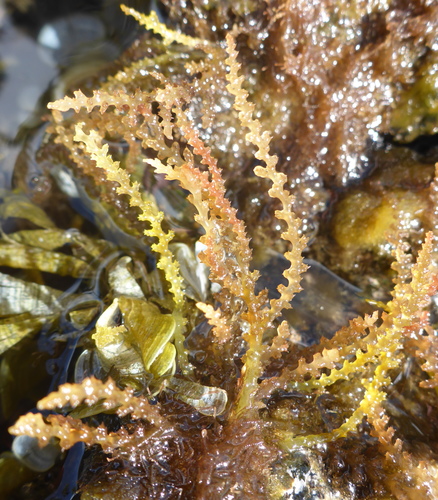
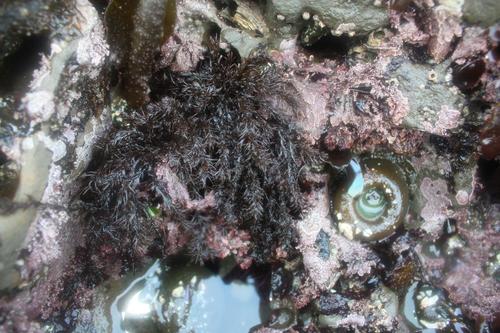
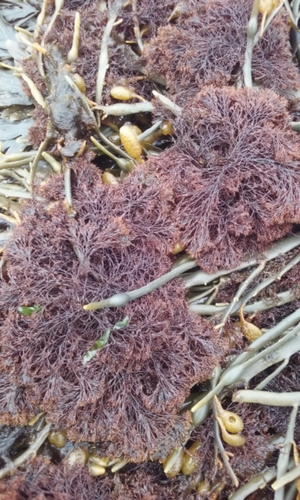
The thalli of Vertebrata lanosa (L.) T.A.Chr. form dense tufts, each up to 7.5 cm tall. These tufts are generally attached to the fronds of Ascophyllum by rhizoids.
Branch Division Pattern
Its erect cylindrical branches show pseudodichotomous division, which produces two equal branches, where one branch grows from a lateral branch.
Transverse Branch Anatomy
A transverse section of a branch reveals a large axial cell surrounded by 12 to 24 peraxial cells. The axial cell fills approximately one third of the branch’s diameter, and this proportion is most clearly visible in transverse section.
Coloration
The alga is a deep brownish red in colour.
Associated Parasitic Alga
Choreocolax polysiphoniae, a small parasitic alga, grows in a cushion shape up to 1 mm in diameter on the branches of V. lanosa.
Epiphytic Growth Habit
This species grows epiphytically, and is widespread. It grows on Ascophyllum nodosum wherever that alga occurs, and occasionally grows on other Fucus species.
British Isles & European Range
Vertebrata lanosa is common around the British Isles, and on European shores ranging from Iceland and Norway to Spain.
North American Range
It is also found from Greenland and Newfoundland to New England.
Life History Phases
The life history of Vertebrata lanosa consists of three sequential phases: gametangial, carposporangial, and tetrasporangial, with two of these phases being similar in form.
Reproductive Biology
This species is dioecious. Spermatangial branches are produced in tufts at the tips of the branches.
Cystocarp Structure
Cystocarps are usually borne singly, each with a narrow ostiole through which carpospores are released.
Tetraspore Formation
Tetraspores form in spiral series, produced by simultaneous division that creates four equal spores.