About Veronica verna L.
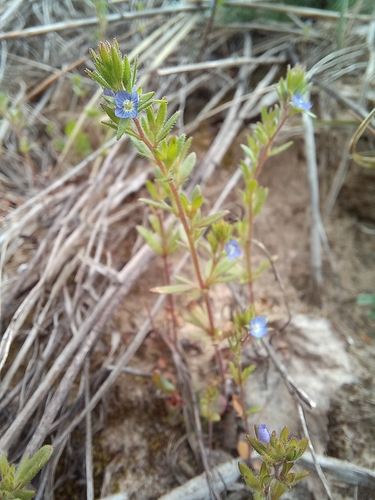
Veronica verna L. is a small annual speedwell, growing 5 to 15 cm tall, with bright blue flowers. Its middle stem leaves are small, reaching up to 12 mm long and 7 mm wide, and are deeply lobed, with lobes extending toward the leaf central axis. The lowest leaves of the plant are not deeply lobed, while the upper bracts located below flowers are narrow and undivided; these bracts may appear divided because they sit beneath a 5-part calyx. As inflorescences mature and produce fruit, they extend in length. Fruit capsules measure 3 by 4 mm, borne on short stalks 1 to 3 mm long, and have short styles 0.5 mm long. Sometimes the characteristic deeply-lobed leaves are not conspicuous, so the plant closely resembles Veronica arvensis unless inspected closely. Photographic examples of this species are available on iNaturalist. Similar species to Veronica verna L. include Veronica dillenii, which has longer styles (1.5 mm), grows taller (up to 20 cm), is more robust, and has larger seeds (1.25 × 1 mm, compared to 1 × 0.75 mm for V. verna). Veronica arvensis lacks the deep leaf lobing of V. verna, and only has shallow leaf incisions. Veronica triphyllos has leaf lobes that extend all the way to the leaf base rather than just to the central axis, and has longer fruiting stalks that measure 4 to 15 mm. This species is native to Europe and south-western Asia, with a native range that extends slightly further north than that of Veronica triphyllos. Its confirmed native regions include Afghanistan, Albania, Altay, Austria, the Baltic States, Belarus, Belgium, Bulgaria, Central European Russia, Corsica, Czechoslovakia, Denmark, East European Russia, Finland, France, Germany, Great Britain, Greece, Hungary, Iran, Italy, Kazakhstan, Kyrgyzstan, Crimea, Morocco, Netherlands, North Caucasus, North European Russia, Northwest European Russia, Norway, Pakistan, Poland, Romania, Sardinia, Sicily, South European Russia, Spain, Sweden, Switzerland, Tajikistan, Transcaucasus, Turkey, Turkmenistan, Ukraine, Uzbekistan, West Himalaya, Xinjiang, and Yugoslavia. It has been introduced to the United States and Canada, where it occurs in British Columbia, New Brunswick, Newfoundland, Nova Scotia, Ontario, Prince Edward Island, Idaho, Indiana, Massachusetts, Michigan, Minnesota, Montana, New York, Oregon, Washington, Wisconsin, and Wyoming. In Europe, it grows in cultivated fields and other dry areas. In Turkey, it can be found in open Pinus and Quercus forests, rocky and sandy steppe, pastures, and meadows, at elevations between 1000 and 2100 m; it is uncertain whether it is a calcifuge.