About Veronica plebeia R.Br.
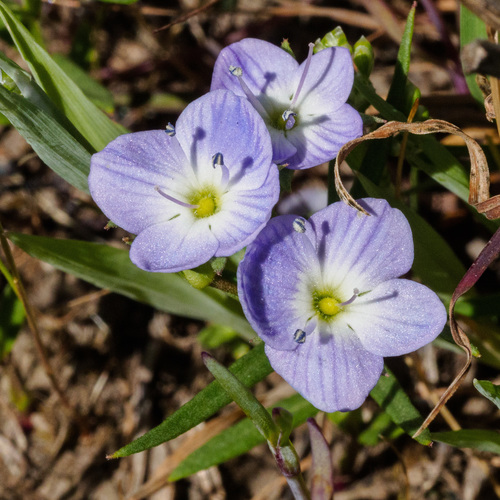
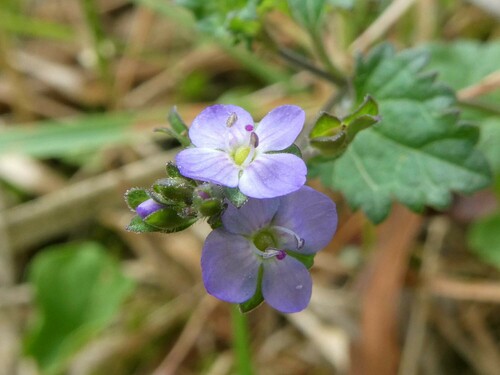
Veronica plebeia, commonly called creeping speedwell or trailing speedwell, is a flowering plant species in the family Plantaginaceae. It is native to Australia and New Zealand. Botanist Robert Brown formally described this species in 1810 in his publication *Prodromus Florae Novae Hollandiae et Insulae Van Diemen*, after collecting it near Sydney in May 1802. A 2012 molecular analysis confirmed that V. plebeia is most closely related to Veronica grosseserrata. V. plebeia is a perennial herb that grows with stolons that can reach up to 1 metre (3 feet) in length. Roots develop at nodes along these stolons. Its flowering stems grow to a maximum height of 10 centimetres (4 inches). The leaves are roughly triangular or heart-shaped (cordate), and measure about 0.8–2 centimetres (0.3–0.6 inches) long and 0.5–1.6 centimetres (0.2–0.5 inches) wide. Lilac to pale blue flowers bloom from September to June, with peak flowering occurring between October and January, and also in April. Flowers grow in clusters containing 2 to 8 individual flowers. Within Australia, V. plebeia occurs in every state and territory except the Northern Territory. It is widely distributed across eastern New South Wales. In Queensland, its range extends north to Tully and the Atherton Tableland. It is rare in Tasmania, where it is restricted to the Tamar Valley and scattered sites along the east coast. In New Zealand, V. plebeia has been recorded from scattered coastal locations on the North Island, northwest Nelson on the South Island, and the Chatham Islands. There has been scientific debate over whether this species is native or naturalised to New Zealand, but its presence in areas with little disturbance supports the conclusion that it is native there. V. plebeia has become naturalised on Norfolk Island. This species grows on clay soils that overlay shale, in multiple vegetation types: wet sclerophyll forest beneath tree species including Eucalyptus viminalis, Eucalyptus fastigata, and Eucalyptus pilularis; dry sclerophyll forest beneath Eucalyptus punctata and Eucalyptus fibrosa; and open woodland beneath Angophora bakeri, Eucalyptus sclerophylla, Melaleuca decora, Eucalyptus moluccana, and Eucalyptus tereticornis. It is thought that native bees and flies pollinate the flowers of V. plebeia.