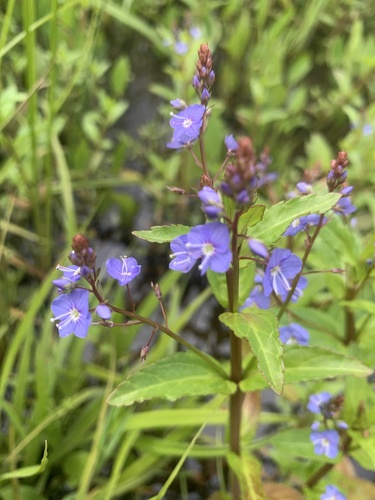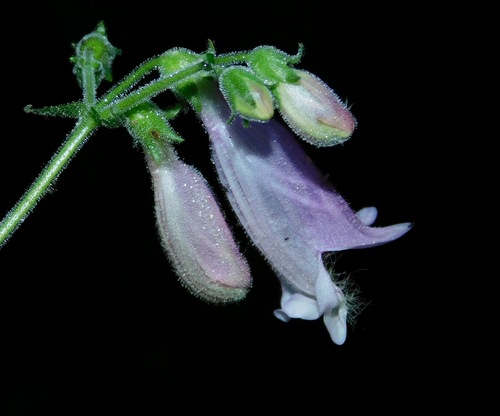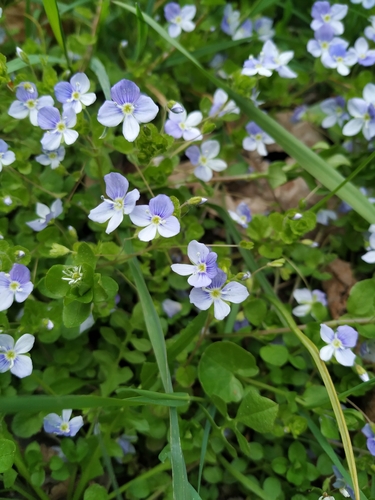
About Veronica filiformis Sm.
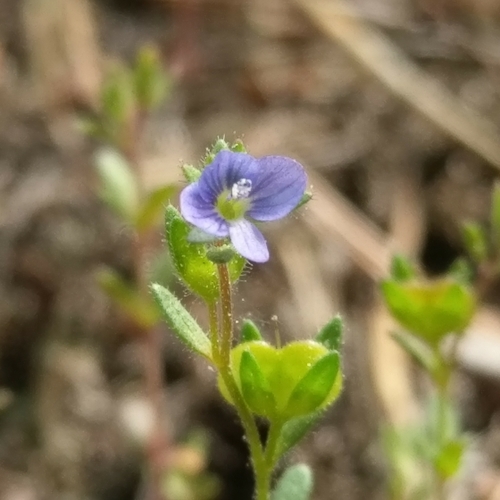
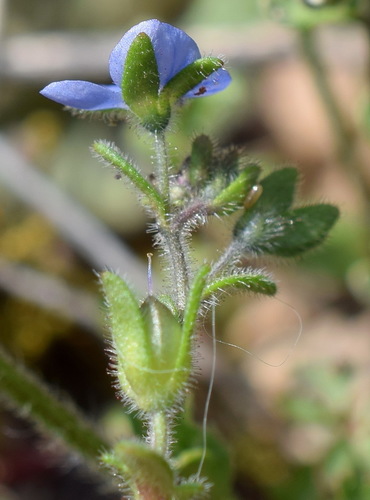
Veronica filiformis Sm. is a rhizomatous perennial herb that forms mats of stems that root easily at nodes that touch the growing substrate. This species is self-sterile and rarely produces seeds, spreading almost entirely via stolons. Its stems grow between 5 and 50 centimeters (2 to 20 inches) long, and may range from having non-glandular hairs to being fully covered in glandular hairs. The corolla of Veronica filiformis is four-lobed, bluish with a white tip, and measures around 8–10 mm in diameter. The top lobe is the largest, as it forms from the fusion of two lobes. Two long, protruding stamens are located at the center of the flower. Single flowers grow in leaf axils, on relatively long, slender stalks that emerge from the leaf axils, and bloom between April and July. Leaves are concentrated near the base of the stem, measure 5–10 mm across, are rounded or kidney-shaped with blunt teeth and short stalks, and become smaller on the more distant (distal) stem sections. It is a perennial plant. In Ireland, this plant was traditionally sewn into travellers' clothing to bring good luck. Veronica filiformis resembles many other species in the Veronica genus, including V. arvensis and V. chamaedrys, but can be identified by its small leaf size and lack of seed capsules. Its small leaves, which are smaller than its flowers or a similar size with a fairly round shape, plus its low carpeting growth habit, also usually separate it from similar species like Veronica persica, Veronica polita, Veronica agrestis, and Veronica ceratocarpa. Veronica filiformis is native to northern Turkey and the Caucasus. It was introduced to the United Kingdom from Turkey in 1808 for use as a rock garden plant, and was first reported as a naturalized escape from cultivation in 1838. It entered the United States nursery trade in the 1920s. It is sometimes considered a weed nuisance in lawns, sod, and turf. It grows in gardens, grassy paths, and meadows, and prefers shaded sites, moist fertile soils, and areas with a low mowing height. It reproduces asexually by resprouting from broken sections of stem and rhizome, allowing it to easily establish itself in new habitats. It is used as a garden groundcover, and is valued for its small, pretty blue flowers. However, it can easily spread into surrounding wild environments when its plant material is chopped up, for example during mowing. It remains cultivated, sold, and used for gardening purposes today.