About Veronica chamaedrys L.
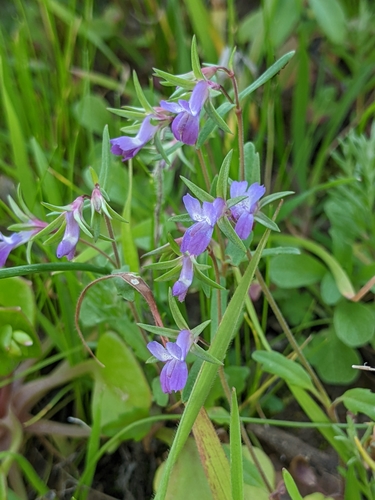
Veronica chamaedrys L. can reach up to 20 cm (7.9 in) in height, but it is often shorter. Its stems only have hair growth along two opposite sides. Its leaves grow in opposite pairs, are triangular with crenate edges, and are either sessile or have short petioles. The deep blue flowers have a zygomorphic (bilaterally symmetrical) four-lobed corolla, and measure 8–12 mm (0.3–0.5 in) wide. The plant's seed capsules are wider than they are long. Blossoms of this species wilt very quickly after picking, which gave it the ironic German common name "Männertreu", meaning "men's faithfulness". When it grows into turf and lawns, Veronica chamaedrys is considered a common, hardy so-called turf weed. It creeps along the ground, spreading by growing roots down at its stem nodes, and reproduces both via seed and stem fragments. Its leaves may defoliate during summer and winter, but its stems will regrow the following season. Unlike at least five other common speedwell species, including corn speedwell (Veronica arvensis), Veronica chamaedrys has opposite leaves on both the upper and lower portions of the plant. For special weed control guidance, see the entry for the genus Veronica. The specific epithet chamaedrys comes from Ancient Greek, as a combining form meaning "low" or "on the ground". This species is native to Europe, and occurs as an introduced species on other continents. In traditional Austrian herbal medicine, Veronica chamaedrys is used internally as a tea to treat disorders of the nervous system, respiratory tract, cardiovascular system, and metabolism. In 18th century Britain, the plant was reputed to cure gout, and was also popularly used to make tea. This latter use became so widespread that the plant was nearly eradicated from the London area during the 18th century.