About Veronica beccabunga L.
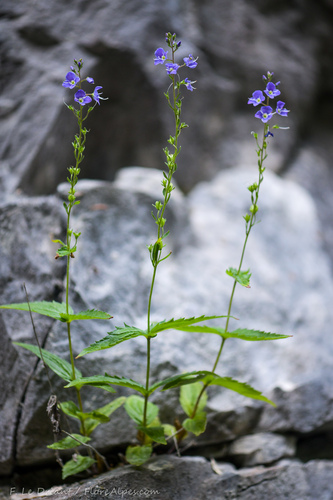
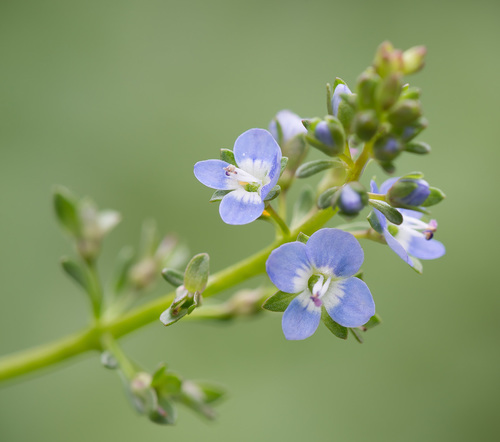
Veronica beccabunga, commonly known as European speedwell or brooklime, is a succulent herbaceous perennial flowering plant in the family Plantaginaceae. It grows naturally on the margins of brooks and ditches across Europe, North Africa, and northern and western Asia. It also occurs as an introduced species on other continents. This species has smooth, spreading, succulent branches that are often reddish. It bears blunt oblong finely serrate leaves arranged in opposite pairs that sit close to the stem, and produces small four-petaled flowers that are bright blue or pink. The specific epithet beccabunga shares a common origin with bäckebunga, an archaic Swedish name for the plant that was in use when Carl Linnaeus first described the species. Names derived from the same origin are still used for the plant in other European languages, including Dutch beekpunge and German bachbunge, which translate to 'brook bunch' or 'brook pouch'. Brooklime was historically one of three traditional antiscorbutic herbs, alongside scurvy grass and watercress, used in purported treatments for scurvy. None of these herbs are actually rich in vitamin C, and the common preparation method of extracting juice would have destroyed most of whatever vitamin C they contained, making these preparations ineffective against true scurvy. However, the plants survive through winter past the first frosts, and may have been one of the only available sources of vitamin C when eaten as a winter salad.