About Veronica anagallis-aquatica L.
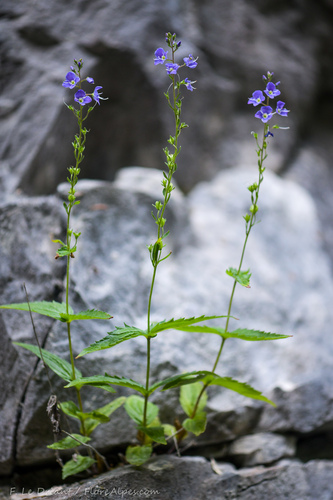
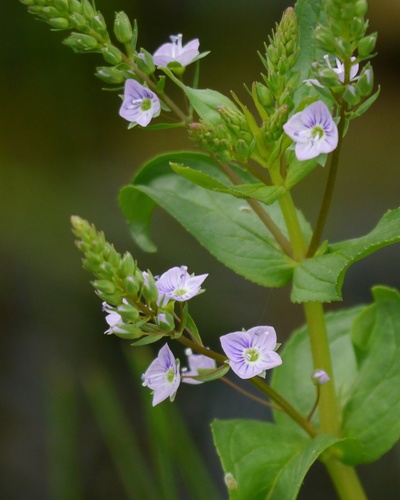
Veronica anagallis-aquatica L. is an upright, short-lived perennial herb. It grows to medium height of around 50 cm (20 in), and may occasionally reach up to 1 m (3 ft 3 in) tall. It produces spikes holding 20 to 40, sometimes up to 60, individual flowers. Each flower is 5–10 mm in diameter, pale violet-blue with darker matching veins, and has four petal-like lobes. Flower spikes emerge from the stem at the points where leaves grow. Leaves are arranged oppositely along the stem, are relatively elongated with pointed tips, clasp the stem, and have serrated teeth along the outer half of their edges. The lowest leaves on the plant are often stalked and lack teeth. In addition to reproducing via seeds, the plant spreads vegetatively early in growth by producing branches that root as they grow. Its main stems curve along the ground, root, then grow upwards to flower. During floods, broken stem pieces can wash downstream and root to form new plants. Key identification characteristics for Veronica anagallis-aquatica include purplish-blue flower colour, bracts that are usually much shorter and narrower than the flower stalk, somewhat elongated fruit, sepals that do not spread wide open when the plant is fruiting, fruiting stalks whose bases do not angle very widely away from the stem, somewhat broad leaves, and stalked lowest leaves. It can be confused with similar related species: Veronica catenata has white or pale pink flowers with rosy pink veins, bracts that extend up to the flowers, fruits that are broader than long, sepals that spread wide open at fruiting, fruiting stalk bases that form a roughly 90-degree angle with the stem, relatively narrow-looking leaves, and unstalked lowest leaves. Veronica × lackschewitzii produces almost no fruit, and is typically noticeably large and robust with large floral spikes. This species is native across the Old World, ranging from southern Africa to Eurasia, and has been introduced to other regions outside this native range. It grows in many types of moist and wet habitats; it is semi-aquatic, and often grows in shallow water along streambanks, in ponds, and in other wetland environments.