About Vernonia gigantea (Walter) Trel.
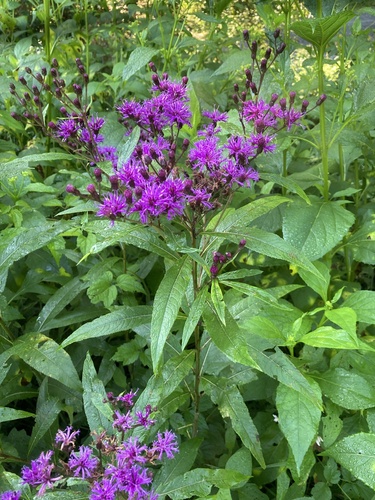
Vernonia gigantea (Walter) Trel. grows between 0.9 to 2.1 metres (3 to 7 feet) tall, or alternatively reaches 1.5 to 3.0 metres in height and 0.3 to 0.6 metres in width (5 to 10 feet tall by 1 to 2 feet wide). Its stem may be green or purplish-green, and can be hairy or pubescent. Leaves are up to 250 mm (10 in) long and 50 mm (2 in) across, and can be ovate, lanceolate-oblong, or elliptical in shape, with serrated margins. The upper surface of leaves is hairless and dark green. Leaf bases may have a petiole or be sessile. Purple flowers bloom from July to September. This plant grows in moist soils along roadsides, and is common in meadows and open woodlands. Its seeds are dispersed by wind. The species is self-incompatible and shows substantial ecotypic variation, a trait that may explain its broad geographic distribution. In ecology, Vernonia gigantea acts as a larval host plant for the ironweed borer moth (Papaipema cerussata) and the red groundling moth (Perigea xanthioides).