About Vernicia fordii (Hemsl.) Airy Shaw
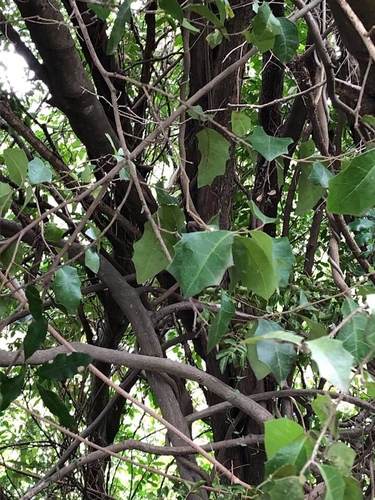
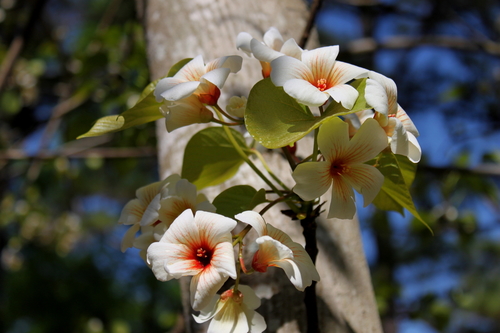
Vernicia fordii is a small to medium-sized deciduous tree that reaches up to 20 metres (66 ft) in height, with a spreading crown. It has smooth, thin bark that produces latex when cut. Its leaves are alternate and simple, ranging 4.5–25 cm long and 3.5–22 cm broad. Leaves are heart-shaped or have three shallow, maple-like lobes, green on both sides, and feature prominent red glands at their base. They attach to the tree via a petiole that is 5.5–26 cm long. The tree's flowers are 2.5–3.5 cm in diameter, with five pale pink to purple petals marked with darker red or purple streaks in the throat. Vernicia fordii is monoecious, meaning individual flowers are either male or female, but both types grow together in inflorescences. Flowers emerge either before or alongside new leaves, produced in loose, terminal clusters. The fruit is a hard, woody, pear-shaped berry 4–6 cm long and 3–5 cm in diameter, holding four or five large, oily seeds. It is green when young, turning dull brown when it ripens in autumn. This species is commonly called the tung tree, and is grown primarily for tung oil, which is extracted from its seeds. Tung oil, also known as China wood oil or nut oil, was traditionally used for lighting lamps in China. Today, it is an ingredient in paint, varnish, and caulk, and is used as a wood finish for furniture and other wooden items. After gums are removed from the oil during processing, it has also been used as motor fuel. Marco Polo recorded in the 13th century that Chinese people kneaded lime, chopped hemp, and this wood oil together into a glue-like mixture that was used to paint ships. The tree has been intentionally introduced to Argentina, Malawi, Paraguay, Thailand, and the United States for commercial tung oil production. Shortly before World War I, seeds received from the United States Ambassador to China were planted in California, but the young trees failed to establish in the region's dry climate. In 1905, David Fairchild of the United States Department of Agriculture successfully introduced the tree to the U.S. Gulf States, ranging from Florida to Texas. After thriving from the 1920s through the 1940s, the American tung oil industry was destroyed by damage from frosts and hurricanes. Hurricane Camille killed many of the remaining tung trees in 1969, and tung plantations never recovered in the United States. Increased competition from overseas production has ended commercial tung cultivation in the U.S., and the tree is now classified as an invasive species in Florida. Global annual production of Vernicia fordii fruit rose from just over 100,000 tonnes in 1970 to almost 200,000 tonnes by 1980. Typical fruit yields range from 4.5 to 5 tonnes per hectare. Several cultivars have been selected for higher yield and smaller mature tree size, including 'Folsom', 'Cahl', 'Isabel', 'La Crosser', and 'Lampton'. The wood of Vernicia fordii is lightweight and strong, and is sometimes used as a substitute for balsa or basswood. All parts of the tung tree are poisonous, including the fruit and seeds, though some parts of the tree were used for medicinal purposes historically. According to the University of Florida Center for Aquatic and Invasive Plants, even a single seed from the fruit can be fatal if consumed; poisoning symptoms include vomiting, diarrhea, and slowed breathing. Contact with the tree's leaves can also cause a skin rash similar to the rash caused by poison ivy.