About Vermivora cyanoptera Olson & Reveal, 2009
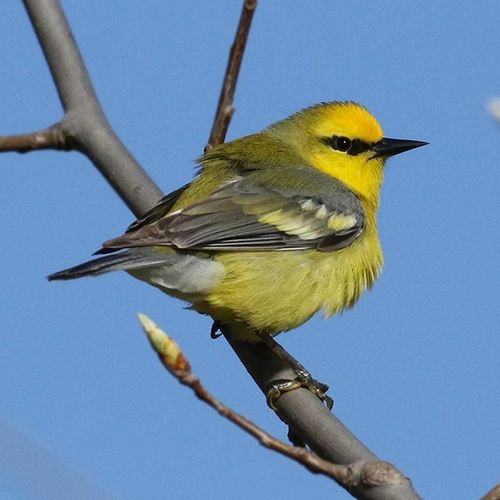
The blue-winged warbler (Vermivora cyanoptera Olson & Reveal, 2009) is a small New World warbler. It measures 11.4–12.7 cm (4.5–5.0 in, or roughly 4.3 to 4.7 inches) in length, has a wingspan of 17–19.5 cm (6.7–7.7 in, or around 5.9 inches), and averages 0.3 oz in weight. It has a well-proportioned body and a heavy, pointed bill. Plumage color varies by sex and age. In breeding plumage, adult males have bright yellow on the head, breast, and unstreaked underparts, along with a narrow black line through the eyes. Their wings are light blueish gray with two white wing-bars, which are diagnostic field marks; overall, males have bright yellow and olive green feathers, with the distinctive black eye line giving their heads a pointier appearance than other male warbler species. Adult females are duller overall, with paler yellow plumage and less yellow on the crown, and their eye line is much less prominent, typically grey and light rather than black. Immature birds are olive green with wings similar to adults; they are smaller than adult blue-winged warblers, have pinkish bills, and almost invisible wing bars. The blue-winged warbler's song is a series of buzzing notes, and its call is a sharp chip. Blue-winged warblers are migratory New World warblers. They winter in southern Central America, and breed in a range that extends from east-central Nebraska in the west, north to southern Minnesota, Wisconsin, Michigan and southern Ontario, east to central New York, southern Vermont, southern New Hampshire and the rest of New England, and south to western South Carolina, northern Georgia, northern Alabama, eastern Tennessee and southern Missouri. It is a very rare vagrant to western Europe, with one individual recorded wandering to Ireland. Their breeding habitat is open scrubby areas. The species is most often found in abandoned fields with shrubs and trees, bordered by tall deciduous trees, generally in areas of higher elevation with a high percentage of grass and canopy cover. The diet of blue-winged warblers consists of insects and spiders. They primarily feed on insects found on various plants including apple trees, walnut trees, and water hemlock. Adults sometimes hang upside down to glean and probe leaves, and gather insect larvae to feed their young; examples of larvae fed to juvenile blue-winged warblers include Aphis sp. and Corythucha sp. Researchers generally presume that the species' diet and feeding methods vary by season and habitat, and may also change based on resource availability, so blue-winged warblers are considered a relatively generalist species.