About Vermivora chrysoptera (Linnaeus, 1766)
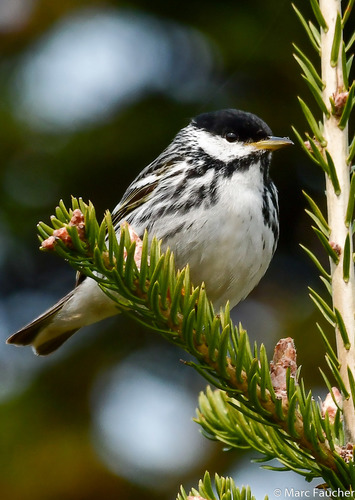
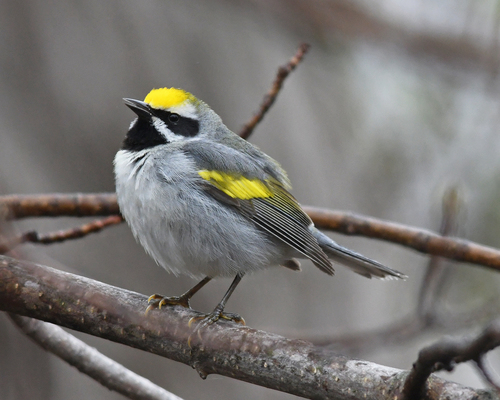
The golden-winged warbler (Vermivora chrysoptera) is a small songbird. Adults typically measure 11.6 cm (4.6 in) long, weigh 8–10 g (0.28–0.35 oz), and have a wingspan of approximately 20 cm. Adult males have a black throat and black mask, with white borders along the mask and throat. Females share the same general pattern as males, but their throats and masks are light gray instead of black. Both sexes have a yellow crown, a yellow patch on the wing, and extensive white coloring on the tail, which is easy to see when viewing the bird from below. The species has grayish white underparts that contrast with its darker gray back, and it has a long, slender bill. Juvenile golden-winged warblers of both sexes look similar to adult females. The species' song is variable, but it is most commonly heard as a trilled bzzzzzzz buzz buzz buzz. Its typical call is a buzzy chip or zip. Golden-winged warblers are migratory birds, split into two distinct breeding populations. One population breeds in the Appalachian Mountains and the Northeastern United States, while the other breeds around the Great Lakes. Appalachian population golden-winged warblers generally migrate to South America to spend the winter, while Great Lakes population birds generally migrate to Central America and Mexico for the winter. Research has found that this difference in wintering location is associated with a genetic difference on the Z chromosome. The species is rarely seen as a vagrant outside of its native range. As neotropical-nearctic migrants, golden-winged warblers change their habitat preferences across seasons. For wintering golden-winged warblers in Costa Rica, individuals select premontane evergreen forest over tropical dry forest plant communities. Golden-winged warblers forage in hanging dead leaves, which are most often created by intermediate disturbances to forest plant communities. During the breeding season, golden-winged warblers nest in shrubland and regenerating forest communities that are created and maintained by ecological disturbance. This reliance on early-successional plant communities is one contributing factor to ongoing population decline in the species. In April 2014, five geotracked golden-winged warblers in Tennessee were observed migrating hundreds of miles south, likely to avoid approaching tornadic storms. All individuals left the area before the storms arrived, possibly after detecting the storms using infrasound.