About Verbesina occidentalis (L.) Walter
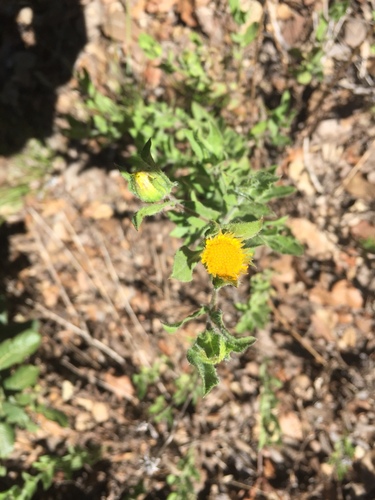
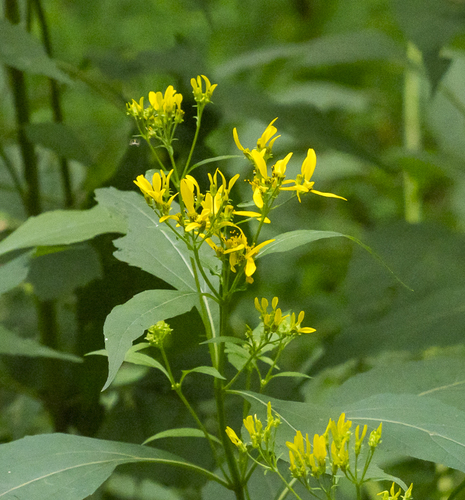
Verbesina occidentalis (L.) Walter is a perennial forb that blooms from August to October, and can reach heights of up to 2.4 meters. As a member of the Asteraceae family, its flower heads are inflorescences made up of 8 to 15 yellow disc florets and 0 to 5 yellow ray florets. These ray florets are sparse and not evenly arranged around the flower head, giving the plant a disheveled appearance. A defining distinctive feature of this species is its winged stem. Its leaves are oppositely arranged, broad and ovate in shape, taper toward the apex, and have serrated margins. Mature leaves typically measure 6 to 16 centimeters long and 3 to 10 centimeters wide, and are glabrous. In terms of distribution and habitat, Verbesina occidentalis prefers full sun, though it can survive in partially sunny locations where it will grow less vigorously. It requires moderate soil moisture and at least moderately nutrient-rich soil. It is commonly found in pastures and hayfields, and also grows along roadsides, fencerows, in parking lots, along creek sides, and in forested areas. This species is native to the United States, where it occurs in all southeastern states except Arkansas. Its range extends west to Texas and east to Delaware; the northern edge of its range reaches Pennsylvania, and the southern edge reaches Florida. Ecologically, Verbesina occidentalis is known to be sensitive to rising ozone levels, and higher ozone concentrations often cause visible foliar ozone injury on the plant. This injury is typically more severe on leaves that receive more sun exposure. In Great Smoky Mountains National Park, around fifty percent of sampled Verbesina occidentalis individuals showed symptoms of foliar ozone injury, and approximately seventeen percent of all sampled leaves were injured. The share of injured plants increases with increasing elevation. Injury symptoms start as a small number of angular stipples, which can range in color from light reddish-purple to black, and become more prominent in late summer. In prolonged cases of injury, leaves turn yellow and may eventually die. Verbesina occidentalis also impacts local plant community diversity and the density of other co-occurring plant species. Studies have found that removing Verbesina occidentalis from a community increases both plant community evenness and Shannon diversity, a common metric used to measure community diversity. Forbs, woody plants, nitrogen-fixing plants, and grasses are all sensitive to the presence of Verbesina occidentalis.