About Verbascum phoeniceum L.
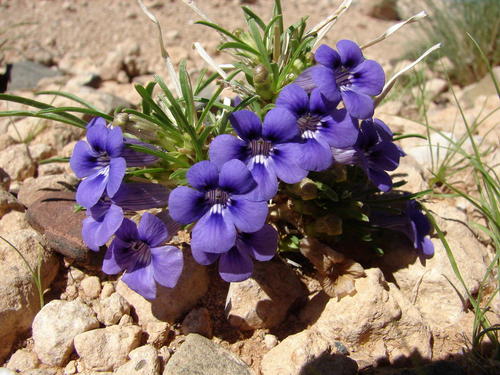
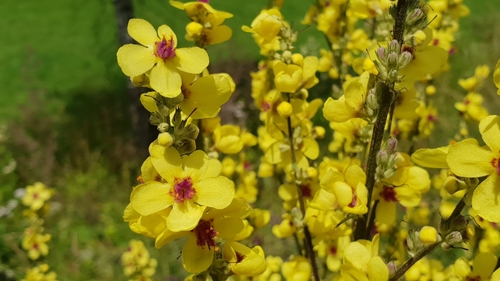
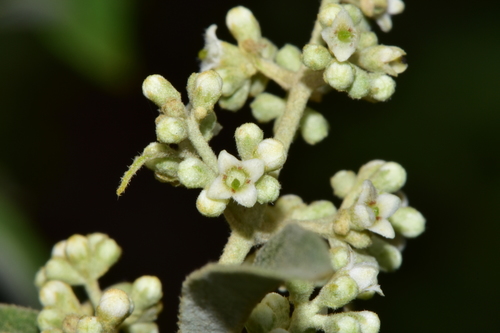
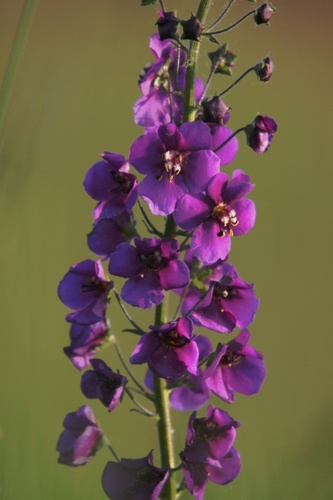
Verbascum phoeniceum L. is a dicot herbaceous plant. It begins growth with a rosette in late spring and continues into summer. The initial lower rosette has whorled basal leaves with pinnate venation; as growth continues, simple leaves grow in an alternating arrangement along the stem. Leaf blade shape can be elliptical, ovate, cordate, or lanceolate, depending on the growing environment. When in bloom, it produces five-petaled flowers arranged in a spike inflorescence, where the first flowers open at the bottom of the spike, and newer blooms open higher up. Like other dicot mulleins, V. phoeniceum has pentamerous perianth and corolla growth. Flower colors range from deep purple (cultivar 'Violetta') to pink (cultivar 'Rosetta') and white (cultivar 'Flush of White'). This color variation makes V. phoeniceum ideal for hybridization with other mulleins. Hybrids can have flower colors from white to various shades of pink and plum, and have a longer growing season due to their perennial nature. Each flower has fuzzy golden-yellow stamens at its center. V. phoeniceum is shorter than most other mulleins, and typically grows between 0.9m and 1.2m tall. Verbascum phoeniceum is native to southern Europe, northern Africa, and central Asia. It grows best in dry soils with full sunlight. While it can tolerate moderate shade, it cannot withstand soggy soils, so it requires efficient water drainage. In its native range, it grows wild on hillsides, in disturbed sites, and in woodlands. It has been introduced to the United States and other temperate regions, where it is cultivated as an ornamental garden plant. It grows well in USDA hardiness zones 4–8, and has been found growing naturally in New York and Ohio, where winter cold is required for seed germination after dormancy. Verbascum phoeniceum is pollinated by hoverflies and bees, though moths are also thought to contribute to pollination. Its flowers release a scent early in the day, which is believed to attract moths, and close by midday. A 2004 study by Branimir Petkovic et al. planted V. phoeniceum on three different soil substrate types: serpentine, andesite, and limestone. Results showed that the plant's morphology and anatomy vary with soil type. Plants grown on serpentine substrate had smaller stem leaves with cordate blades and dentate margins; plants on limestone substrate had lanceolate stem leaves with entire margins; plants on andesite substrate had even narrower cordate stem leaves with dentate margins. Overall, serpentine soil produces lower average values for V. phoeniceum traits including plant height, inflorescence length, number of flowers, and pedicel length, while limestone produces the highest values, and andesite produces intermediate values. The first observation of self-incompatibility in plants was made on V. phoeniceum in the late 18th century, and published by Joseph Gottlieb Kölreuter. Unlike other mulleins such as V. thapsus and V. lychnitis, which can self-pollinate, V. phoeniceum pollinated with its own pollen does not set seed, but is cross-fertile; this trait is attributed to the plant's allotetraploidy. Despite having perfect flowers, individual V. phoeniceum flowers tend to show either extreme male or extreme female characteristics, and pollination is more successful when using flowers in this form. V. phoeniceum has a chromosome count of 2n = 32 or 36. V. phoeniceum is self-seeding; it freely drops its seed pods where it grows to add to the soil seed bank. Horticulturists growing V. phoeniceum often deadhead flowers to keep the plant in continuous bloom throughout its short lifespan as a perennial. V. phoeniceum is cultivated as an ornamental plant, used to add vertical accents to gardens. It prefers alkaline or poor soil in a sunny location. Several cultivars have been developed in a range of flower shades.