About Verbascum lychnitis L.
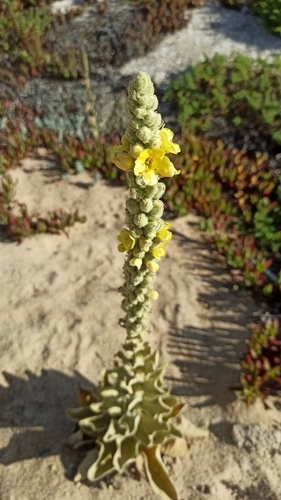
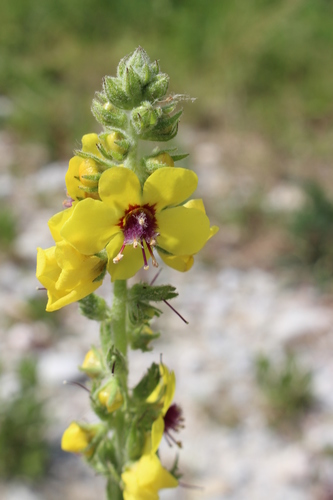
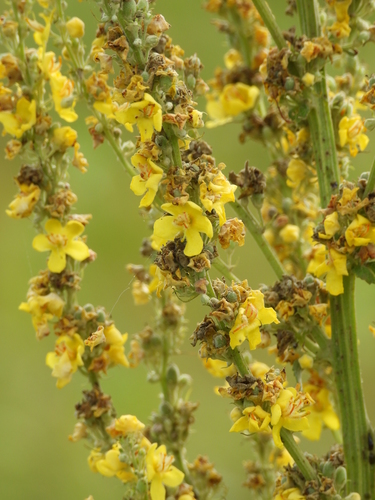
Verbascum lychnitis, commonly known as white mullein, is a flowering plant belonging to the figwort family, Scrophulariaceae. It is native to Asia and Europe, and has naturalized in parts of North America. The species was first formally named by Carl Linnaeus in 1753. Despite its common name, its flowers can be either white or yellow. It is a biennial or short-lived perennial that commonly grows in disturbed areas. This species can be distinguished from other species in the genus Verbascum by several key traits: its stem leaves are sessile and non-clasping, with upper and lower surfaces of different colors; its small flowers are spaced apart rather than tightly bunched, unlike in other mulleins; and its flower stalks are somewhat long. Like other mulleins, the leaves of Verbascum lychnitis are covered in dendritic hairs. In V. lychnitis, these hairs are very short (less than 0.2 mm), which makes them appear stellate. The lower leaf surface is much hairier than the upper surface. V. lychnitis hybridizes with other mullein species, including V. nigrum, V. pulverentum, and V. thapsus.