About Venusia cambrica Curtis, 1839
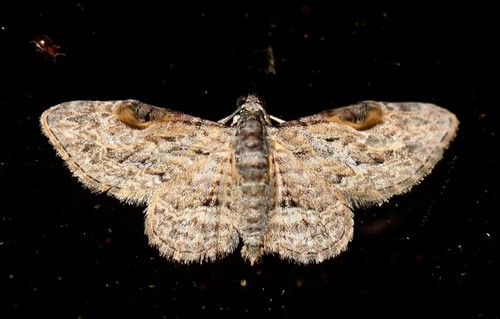
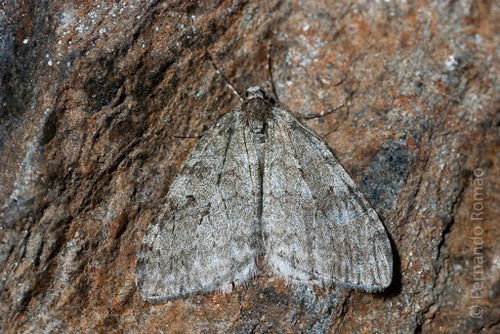
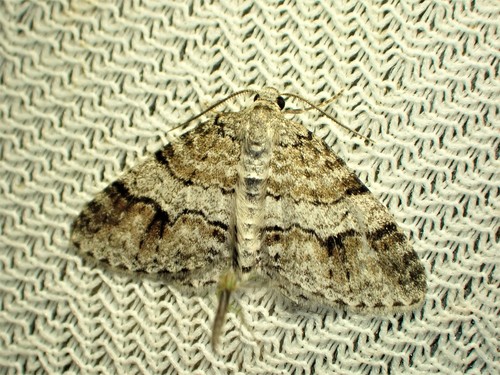
Venusia cambrica, commonly known as the Welsh wave, is a moth species belonging to the family Geometridae. Its distribution covers Europe, western and central Siberia, Altai, Transbaikalia, the Russian Far East, the Korean Peninsula, and Japan. It is also found in North America, where it occurs across Canada from Newfoundland and Labrador to British Columbia; in the west it ranges south to California, and in the east it ranges south to Georgia. This species has a wingspan of 27 to 30 mm. Its forewings are light grey with black and brown cross lines. The most noticeable characteristic is two protruding black lines on the outer black cross line, near the center of the wing. This species is quite distinct. The black marks on the 3rd radial and 1st median located distally to the outer line are reminiscent of the genus Oporinia. On average, English specimens and, according to Herz, the Korean form, are slightly less white than specimens from Scotland and continental Europe. In general, females are slightly larger and paler than males. Several accepted aberrations are described: ab. pygmaea Tystr. is a small form with a constricted central wing area. ab. latefasciata Strand has a very broad median wing area, and the lines bounding this area are parallel, rather than close together in the posterior part. ab. webbi Prout has markings that are almost entirely obliterated, except those at the costal margin and on the median vein and its branches, and resembles Oporinia autumnata gueneata. ab. bradyi Prout has both wings uniformly suffused with dark smoke-color, and this form is becoming more frequent in the Sheffield district. ab. lofthousei Prout is a melanotic form quite different from ab. bradyi; its forewing is suffused with smoke-color but remains longitudinally streaked with white in the distal area, and its hindwing is not darkened. This form is only known from North Yorkshire. The larvae of Venusia cambrica are long and slender, with a few short setae. They are green with large purple spots on the back and sides. In western Europe, adult moths are active on the wing from July to August; in New Brunswick and Quebec they are on wing from June to September; in California they are active from March to August. This species has two generations per year. Larvae feed on the leaves of Sorbus aucuparia. Other recorded host food plants include alder, apple, birch, mountain ash, serviceberry, and willow.