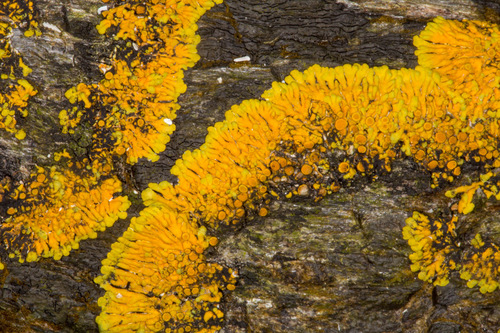
About Variospora thallincola (Wedd.) Arup, Frödén & Søchting
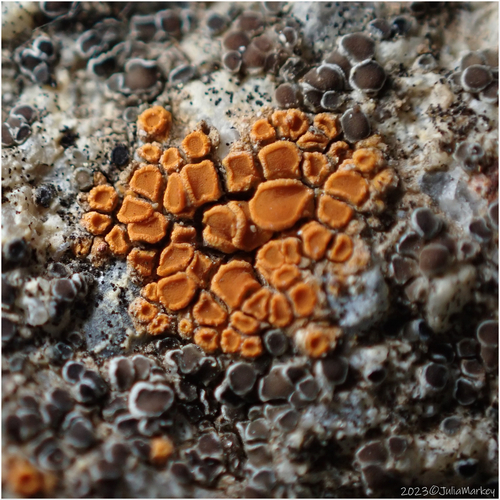
Variospora thallincola is characterized by a bright orange, placodioid thallus that forms tightly appressed, circular structures resembling cartwheels, each 3–4 cm in diameter. The thallus has convex, finger-like lobe ends around 0.3–0.7 mm wide; these lobe ends lie close together, separated by often parallel furrows. The central area of the thallus is convex and areolate, and does not have pruina, a powdery or waxy coating. This species produces apothecia, its fruiting structures, which reach up to 0.8 mm in diameter and are generally scattered across the thallus's central area. The thalline margin of the apothecia is orange, and becomes excluded as the apothecia age. The apothecial discs are brown-orange, and change from flat to convex as they mature. Inside the apothecia, the sterile filamentous paraphyses are loose: some are simple, while most branch into forks toward their slightly swollen tips. The ascospores of Variospora thallincola are distinctively swollen and lemon-shaped, measuring 11–14 by 8–11 μm, with a septum that is 4–5 μm wide, making up half of the ascospore's total length. Both the thallus and apothecia turn purple in a potassium hydroxide (K) spot test. Variospora thallincola grows on siliceous stone in rocky coasts, most commonly in the mesic to submesic-supralittoral zones. It prefers shaded, north-facing rock surfaces. This lichen is widely distributed, with confirmed reports from Africa, Asia, Europe, and North America.