About Variospora flavescens (Huds.) Arup, Frödén & Søchting
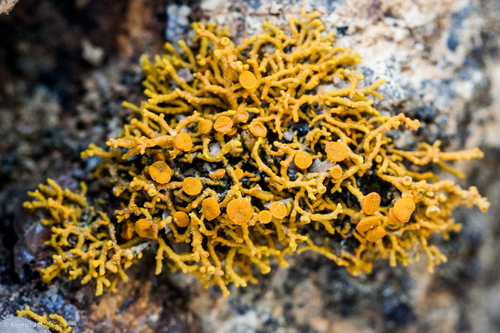
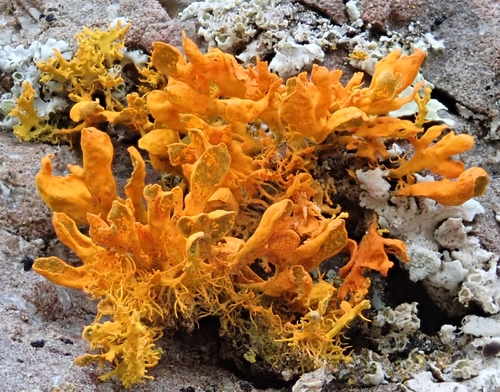
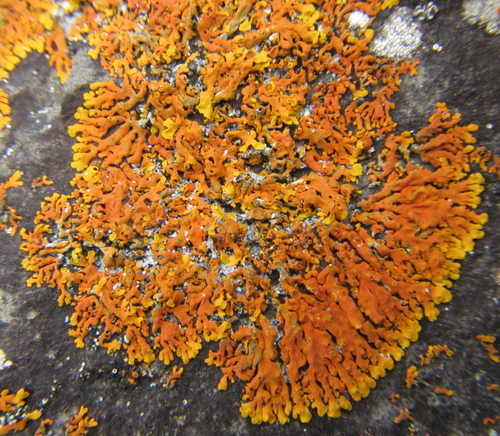
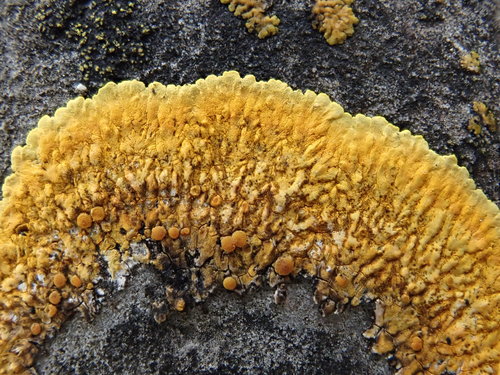
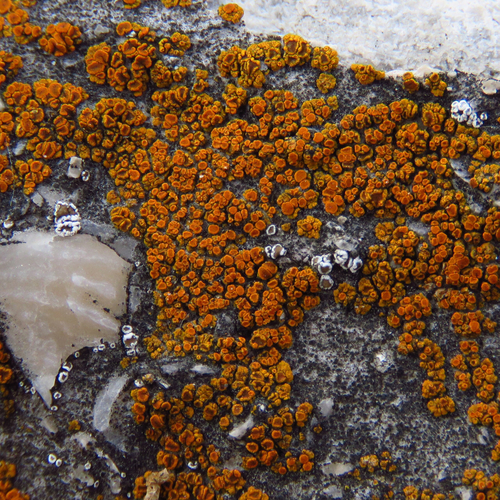
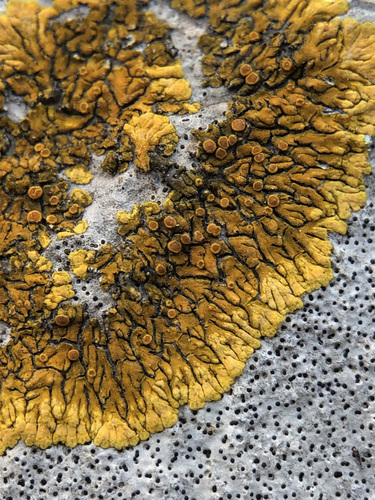
Variospora flavescens has a placodioid thallus that forms large, evenly distributed circular patches reaching 10 cm (4 in) or more in diameter. The thallus lobes are closely appressed, with rounded or irregular shapes. Their surface has a matte texture, and ranges in colour from pale to deep orange. The lobe ends of this lichen species are not widened; they are rounded and convex, and can sometimes look faintly pruinose, meaning they have a white, waxy, powdery coating. The lobes are pleated, sometimes overlapping, and positioned close to one another. The centre of the thallus has a closely areolate, uneven texture, made up of occasionally contorted, congested lobes. These central lobes are white and non-pigmented, but are spotted with orange apothecia. These cup-shaped fruiting bodies grow up to 1.5 mm in diameter. They are mostly found in the centre of the thallus, and are typically abundant and crowded. When young, apothecia are flat, and become convex as they mature. The thalline margin, the border of the apothecium, matches the colour of the disc initially, and becomes excluded over time. The disc ranges in colour from orange to orange-brown. When viewed in microscopic cross-section under polarised light, the thallus has small orange crystalline deposits in the upper cortex, consistent with anthraquinone pigments, while the inner cortex may contain larger, colourless crystals thought to be calcium oxalate. The paraphyses, which are sterile fungal filaments, are slender and range from straight to flexuose, with no noticeable swelling at their ends. The lemon-shaped ascospores measure 12–15 by 8–10 μm, and are swollen at the septum. The septum can be up to 5 μm wide, with varying breadth. Variospora flavescens is a saxicolous lichen that grows on calcareous stone, including limestone, mortar, and cement. It is rarely found growing on bark, and these occurrences are typically restricted to sites near dusty lime quarries. It has a wide distribution, and has been recorded in Africa, Asia, Europe, and Macaronesia. It was first documented in India in 2017. Jan Vondrák and colleagues have suggested that the eastern limit of V. flavescens' distribution lies in Dagestan, a Caucasian biodiversity hotspot. In the United Kingdom, it is quite common, but does not occur in air-polluted areas such as industrial regions of Northern England, nor does it occur in the Scottish Lowlands.