About Vanessa virginiensis (Drury, 1773)
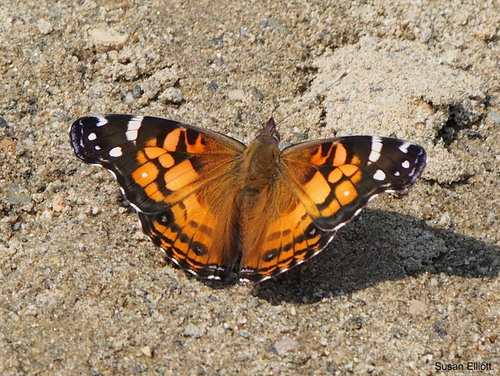
Vanessa virginiensis is most easily distinguished from closely related species by wing markings. It has two large eyespots on the ventral wing side, while Vanessa cardui has four small eyespots and Vanessa annabella has none. This species also uniquely has a white dot within the forewing subapical field; this dot is set in pink on the wing underside, and it is usually also present in the orange field of the dorsal wing side. The largest spot in the black forewing tips is white in V. cardui, pale orange in V. virginiensis, and orange in the West Coast Vanessa species. The West Coast species also has a purer orange dorsal background color, in contrast to the darker and especially redder dorsal hue shared by V. virginiensis and V. cardui. A less reliable identification marker is the row of black eyespots on the dorsal submarginal hindwing. In V. virginiensis, the American painted lady, the eyespots at opposite ends of this row are often larger and have blue "pupils". In V. annabella, this same pattern of larger size and blue pupils applies to the inner two spots of the row. In V. cardui, some black eyespots may have tiny blue pupils in the summer morph, but they usually have no blue pupils at all, and all the eyespots themselves are roughly the same size. The wingspan of V. virginiensis measures about 5 cm (2 in) across.