About Vanessa tameamea (Eschscholtz, 1821)
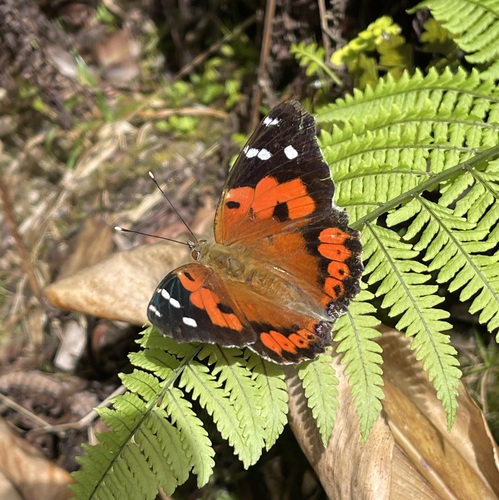
Vanessa tameamea, the Kamehameha butterfly, is a medium-sized butterfly in the Nymphalid family. It has dark base coloration with reddish orange markings. Sexual dimorphism, which is unusual for the Vanessa genus, appears in a set of three small spots on the anterior forewing: these spots are typically white in females and orange in males. Visually, this species falls between the groups commonly called ladies and admirals, and its closest morphological relatives are Vanessa indica and V. samani. The caterpillars of this species feed on leaves of plants from the Urticaceae family, most commonly māmaki (Pipturus albidus), and also feed on ōpuhe (Urera spp.), ʻākōlea (Boehmeria grandis), olonā (Touchardia latifolia), and maʻoloa (Neraudia spp.). Adult butterflies feed on sap from koa (Acacia koa) trees. This butterfly occurs on all four major Hawaiian Islands—Oʻahu, Kauaʻi, Maui, and the Big Island—and also on Lānaʻi. It has been lost from most of its historical range, due to the decline of native forest habitat, loss of required native host plants, and widespread predation by non-native species. Conservation initiatives including the Hawai’i Invertebrate Program (HIP) and local projects run by the Division of Forestry and Wildlife continue to rear this butterfly and work to maintain wild populations on O'ahu and the Big Island. Most modern sightings are in high elevation damp forests, such as the forests within Hawaiʻi Volcanoes National Park, Mokulēia Forest Reserve, and Waimea Canyon State Park.