About Vanessa kershawi (McCoy, 1868)
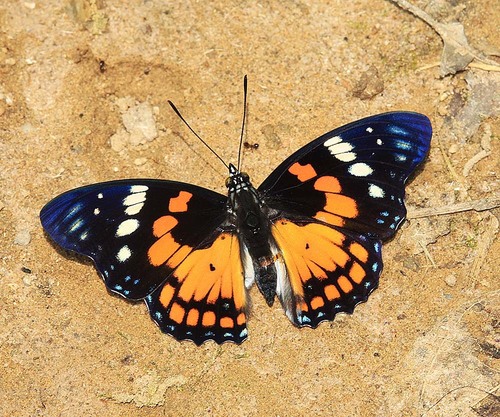
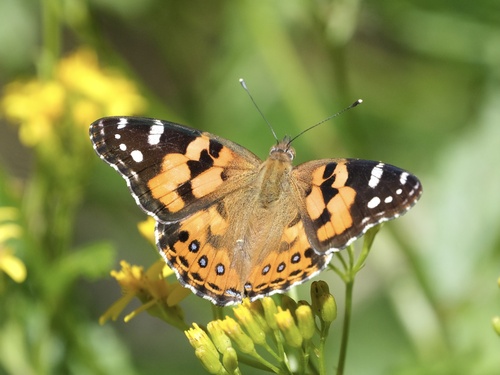
The Australian painted lady, scientifically known as Vanessa kershawi, is remarkably similar to the closely related painted lady, Vanessa cardui. It can be distinguished by its smaller size, rarely exceeding 2 inches (5 cm) across its wings, and the blue colouration at the centre of the four eyespots on its hindwings. Its entire body is dark brown, almost black, except for the white tips of its antenna. The base of its wings is brown, which transitions to brick red, broken by black bands. The tips of the forewing are black, with four white dots running from the wing's apex and a white bar extending from the forewing's leading edge. The hindwings have four round eyespots at their base, with at least three having a blue centre. The underwings are almost identical to the upperwings, with the only difference being that the base of the underwings is brick red rather than brown. The Australian painted lady's colouration allows it to blend effectively into the ground. Males and females look almost identical. The ovum is translucent green, barrel-shaped, and marked with 13 to 15 vertical ribs. Just before hatching, the black head and grey-tinted body become visible through the egg shell. The larva is grey with pale yellow stripes running along each side of its body and yellow dots, and its body is covered in rows of branched spines. Its head is typically brown or black, and the caterpillar grows to around 3 cm. The pupa is brown with darker markings, and has four pairs of metallic silver or gold dots. This species is originally restricted to Australia, while the closely related V. cardui is found across the rest of the world, giving the two species an allopatric distribution. Within Australia, the Australian painted lady is common across all of southern Australia, below the Tropic of Capricorn. It is uncommon to find this butterfly in Queensland, and it is completely absent from the far north of the country, in the tropical rainforests. Though it is most common in Australia, it has also become common across New Zealand after periodic sea migrations from Australia. Since these butterflies do not reproduce or overwinter in New Zealand, they are only considered an established species in Australia. Within its native range, it occurs in urban areas. Fragmented habitats from urbanization, plus environmental disturbances from humans and introduced species, are harmful to most butterflies. Additional threats to local vegetation include recreation, vegetation trampling, altered fire regimes, and the introduction of plant pathogens, all of which cause changes to local plant communities. Butterfly distribution depends heavily on site characteristics and the density of the species' host plants. Changing plant composition alters most butterflies' range distribution, isolating them into small pockets where vegetation remains suitable. Because the Australian painted lady uses a wide variety of host plants, it has not been significantly affected by these changes. In New South Wales, it has been recorded using some species of carduine thistles, which are invasive to Australia, as host plants. Australian painted ladies use these plants as hosts during their larval stage and as food sources, but they inflict very little damage to the plants. The Australian painted lady typically uses native Australian everlastings and other daisies as host and food plants. However, it also feeds on several introduced species, including capeweed (Arctotheca calendula), Scotch thistle (Onopordum acanthium), and lavender (Lavandula angustifolia). Adult Australian painted ladies feed on flower nectar.