About Vanessa gonerilla (Fabricius, 1775)
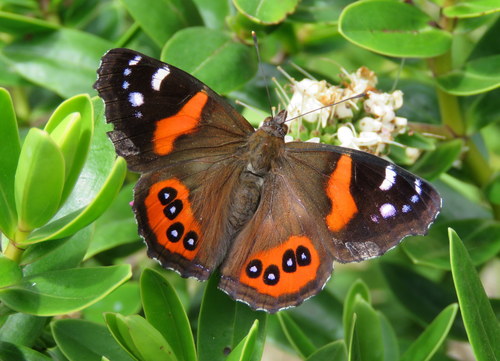
Vanessa gonerilla, commonly known as the New Zealand red admiral, is a medium-sized butterfly with a 50–60 mm wingspan. The upperside of its forewings is mostly black, with a central bright red bar running back from the front edge. White spots fringed with light blue sit near the tips of the forewings. The hindwings are dark reddish brown with a red patch holding four black circles, each with a pale blue center. The underside of the hindwings is a mottled mix of white, brown, and black shapes that camouflages the butterfly when it is at rest. When the forewings are opened, their underside shows a striking blue eyespot framed by white and red arcs. This species is relatively common across New Zealand in areas where its food plants grow. Anecdotal evidence indicates its population has declined since the early 1900s, and the butterfly has reportedly disappeared from Auckland. Population decline is linked to pesticide spraying and the loss of native nettle plants; nettle populations are also impacted by drought. Currently, nettle species are cultivated as butterfly food by NZ Forest & Bird and some New Zealand local councils. Exotic parasitic wasps are another contributing factor to the red admiral's decline. The Australian white-spotted ichneumon wasp Echthromorpha intricatoria arrived in New Zealand on its own, while the pteromalid wasp Pteromalus puparum was introduced by government entomologists between 1932 and 1933 to control the invasive cabbage white butterfly Pieris rapae, a major agricultural pest in New Zealand. One study conducted on Banks Peninsula found that 1–19% of red admiral pupae were parasitized by P. puparum, and 20–30% were parasitized by E. intricatoria. The primary host plant for red admiral larvae is the native stinging nettle, or ongaonga (Urtica ferox), though larvae can also feed on other Urtica species. Throughout their development, larvae hide on nettle leaves during the day: small larvae roll a leaf edge around themselves, while larger larvae fold a leaf into a protective tent. Green, barrel-shaped, ribbed eggs are typically laid one at a time on a leaf. Red admiral larvae only eat enough of their eggshell to emerge, unlike the closely related yellow admiral larvae that consume the entire eggshell. Larvae go through five growth stages called instars. For around the first 10 days, larvae have a brown body with small white spots and fine hairs called setae. After their first molt at approximately 2.5 mm long, larvae develop a pale stripe along the body just above the legs, and their setae begin to develop spikes, usually two or more at this stage. Larvae molt again when they reach about 5 mm long, and their pale longitudinal stripes become more distinct. They molt a third time at about 10 mm long, and their setae grow additional spikes. The final molt occurs when larvae are around 22 mm long; after this molt, caterpillars grow to approximately 36 mm before pupating into a roughly 20 mm pupa. Red admiral and yellow admiral caterpillars are hard to tell apart. The key visible difference is that yellow admiral larvae have a wider light-colored area on the 4th and 6th body segments than red admiral larvae. When compared side by side, red admiral pupae tend to be thinner and longer than yellow admiral pupae, but are otherwise very difficult to distinguish. Adult red admirals are most common during the summer. They overwinter as adults, so they can be seen on warm winter days. They are long-lived: summer adults survive up to six months, and overwintering adults may live up to nine months. Adult butterflies feed on nectar from a range of native and introduced plant species, and occasionally feed on tree sap seepage. They are strong fliers. Their short flights during feeding and ovipositing are very erratic, while flights over water or mountain ranges are straight and fast, a trait characteristic of migrating butterflies. However, no migration within New Zealand has been recorded for this species.