About Vanda tessellata (Roxb.) Hook. ex G.Don
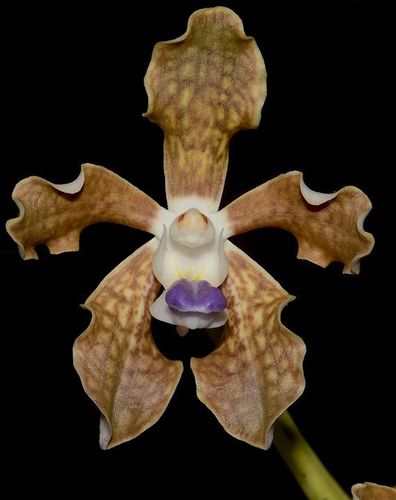
Vanda tessellata (Roxb.) Hook. ex G.Don is an epiphytic perennial orchid. Its stem is 30–60 cm long, stout, and scandent, supported by stout, simple or branching aerial roots. The leaves are succulent, 15–20 cm long, linear, recurved, and complicate. Flowers grow in racemes that hold 6–10 blooms each; the total length of the raceme including the peduncle is 15–25 cm. Sepals are yellow, marked with a brown tessellated pattern and edged with white margins. Petals are also yellow with brown lines and white margins, and are shorter than the sepals. The lip is 16 mm long, bluish, and dotted with purple. Capsules are 7.5–9 cm long, narrowly clavate-oblong with acute ribs.
This species has a number of recorded medicinal uses. Its roots are alexiteric and antipyretic, and are considered useful for treating dyspepsia, bronchitis, inflammations, piles, and hiccup. Externally, the root is used to treat rheumatism, related disorders, and diseases of the nervous system. It is also used as a remedy for secondary syphilis and scorpion stings. Leaf juice is used topically for otitis, and a leaf paste is used as a febrifuge. Roots of Vanda tessellata have significant anti-inflammatory activity, and produce potent analgesic effects paired with relatively low toxicity. In 2013, a novel aphrodisiac compound, 2,7,7-tri methyl bicyclo [2.2.1] heptane, was discovered in this orchid.
There are unconfirmed reports of this plant being used as an entheogen in India. Ayurvedic shamans in India are said to have used the plant to induce the hypnotic narcosis needed for their work, leading to a transcendent state of being. They are reported to have first learned of this orchid’s intoxicating properties by observing bees that fed on its nectar become stupefied and fall to the ground. Evidence for this traditional practice is sparse, but the presence of alkaloids in V. tessellata and its well-documented use for nervous system diseases makes this use inherently plausible. Similarly, Tantric magicians are said to have ingested the fleshy roots of this species as an aid for divination, alongside the tubers of another orchid, Dendrobium macraei (which has synonyms Ephemerantha macraei and Flickingeria macraei; the genus Flickingeria is currently unaccepted, but the name is still used in the horticulture trade).