About Valeriana edulis Torr. & A.Gray
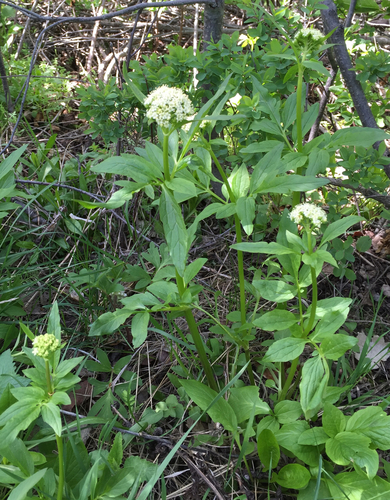
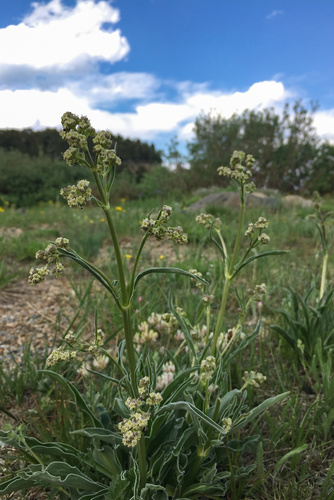
Valeriana edulis Torr. & A.Gray, commonly called edible valerian, is a long-lived herbaceous plant. It produces a long, often forked, cone-shaped taproot 0.8 to 3 centimeters thick; the root has a black exterior and bright yellow interior. Atop the taproot sits a short, branched caudex covered by the deep brown to nearly black persistent leaf bases from previous growing seasons. Inflorescences grow on elongated stems that bear few leaves, and these stems usually reach 0.5–1.5 meters in height. The plant’s flowers are small and cream or white: pistillate flowers are 0.5 mm in diameter, while staminate flowers measure 2.5–3.5 mm across. In the United States and Canada, blooming can occur as early as June and as late as August; in Mexico, subspecies procera blooms and sets seed between August and October. Edible valerian is native to North America, where its native range is split into two distinct populations. The eastern population, classified as variety ciliata, grows in the Midwestern United States, specifically in southeastern Minnesota, Iowa, southern Wisconsin, northern Illinois, northwest Indiana, Ohio, and southern Michigan, and extends across the Canada–United States border into southwestern Ontario. This population grows primarily in glaciated areas, in habitats such as swamps and bogs, and also occurs in the Driftless Area of southwestern Wisconsin. The northernmost point of the western population’s range is southern British Columbia, Canada. In the United States, this population occurs in eastern Washington and Oregon, across most of Idaho, and western Montana; it is only recorded in three western counties of South Dakota, but is widespread across Wyoming, in the western mountainous counties of Colorado, and across Utah and Nevada, and it is not found in California. It is also native to Arizona and New Mexico. All populations of the species in northern North America belong to subspecies edulis, while the species’ range overlaps in parts of Mexico with subspecies procera. In northwestern Mexico, subspecies procera only grows in Sonora. In northeastern Mexico, it is found in Chihuahua, Coahuila, Durango, San Luis Potosí, Hidalgo, Aguascalientes, and the Gulf coast state of Veracruz. It is recorded from all central Mexican states, including Mexico City, the State of Mexico, Morelos, Puebla, and Tlaxcala. In southwestern Mexico, it occurs in every southwestern state including Nayarit, Jalisco, Colima, Michoacán, and Oaxaca, but it is not found in Guerrero, and it does not extend into southeastern Mexico. Edible valerian most commonly grows in moist montane meadows and subalpine parks. In the Intermountain West, it grows at elevations as low as 1,400 meters (4,600 ft); in Utah, it can be found growing as high as 3,700 meters (12,100 ft). The small, shallow flowers of edible valerian make its pollen and nectar accessible to a wide variety of small generalist pollinators. In Colorado, solitary bees, flies, and moths are the most common visitors to its flowers. Growth data shows that individual edible valerian plants can live up to 300 years. Edible valerian has a long history of use as food. One of the earliest written accounts comes from explorer John Charles Frémont’s 1840s journal, which records: I ate here, for the first time, the kooyah, or tobacco root, (Valeriana edulis) the principal edible root among the Indians who inhabit the upper waters of the streams on the western side of the mountains. It has a very strong and remarkably peculiar taste and odor, which I can compare to no other vegetable that I am acquainted with, and which to some persons is extremely offensive. It was characterized by Mr. Preuss as the most horrid food he had ever put in his mouth; and when, in the evening, one of the chiefs sent his wife to me with a portion which she had prepared as a delicacy to regale us, the odor immediately drove him out of the lodge; and frequently afterwards he used to beg that when those who liked it had taken what they desired, it might be sent away. To others, however, the taste is rather an agreeable one, and I was afterwards always glad when it formed an addition to our scanty meals. It is full of nutriment; and in its unprepared state is said by the Indians to have very strong poisonous qualities, of which it is deprived by a peculiar process, being baked in the ground for about two days. Botanist Harold Harrington and his colleagues tested multiple methods of cooking the roots, including boiling for different lengths of time with frequent water changes, baking in aluminum foil, and soaking with sodium bicarbonate, and ultimately agreed with Charles Preuss that the taste is offensive. They described the flavor as similar to chewing tobacco, with an odor like unwashed feet. However, they did note that spring is the best season to harvest the roots, as they are less fibrous than fall-harvested roots and have less insect damage. Botanist David Douglas recorded observations of Indigenous peoples cooking the roots during his travels through northwestern America. He wrote: The roots during the spring months, are collected by the Indians, baked on heated stones, and used as an article of winter or spring food. From a bitter and seemingly pernicious substance, it is thus converted into a soft and pulpy mass, which has a sweet taste, resembling that of treacle, and is apparently not unwholesome.