About Valanga nigricornis (Burmeister, 1838)
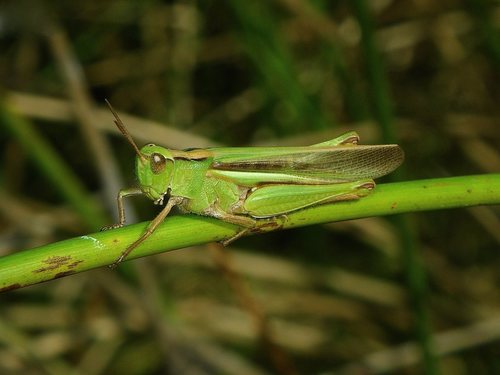
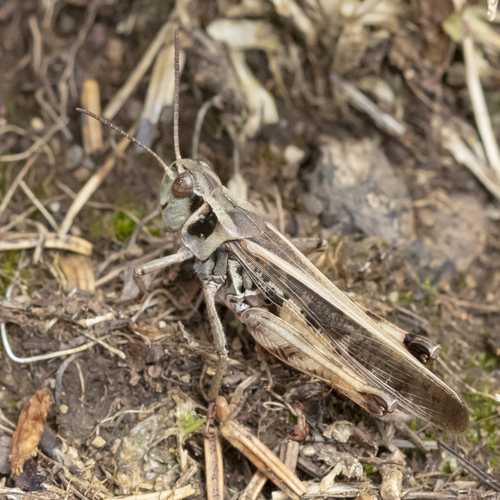
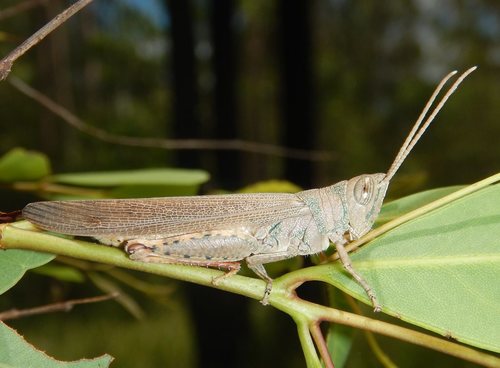
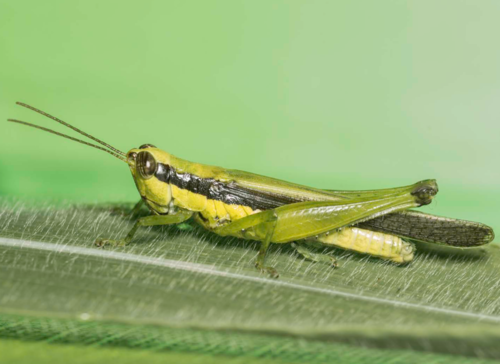
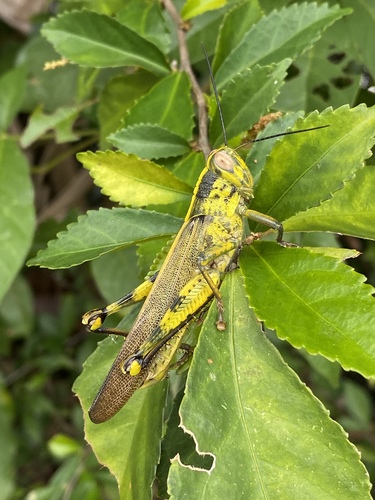
This species shows considerable sexual dimorphism: adult males measure 45 to 55 millimetres (1+3⁄4 to 2+1⁄8 inches) in length, while adult females measure 15 to 75 millimetres (5⁄8 to 3 inches) in length. Adult individuals are yellowish-brown, yellowish, or green, with bluish-black markings. The hind wings, which are visible during flight, are rose red. Nymphs are pale green with dark markings. Valanga nigricornis, commonly called the Javanese grasshopper, is native to Brunei, Cambodia, Indonesia, Malaysia, Papua New Guinea, the Philippines, Singapore, the Solomon Islands, Thailand, and Vietnam. It is primarily a woodland species, found in forest clearings, on trees, and on shrubs. It can become a serious pest in oil palm and rubber plantations, which are common throughout its native range. The species has also been recorded in Australia (only on Christmas Island, located 430 kilometres (267 miles) south of Java), Guam, India, Micronesia, and Palau. The Javanese grasshopper’s life cycle varies across different parts of its range, but in general, it produces one generation per year. Females lay up to four egg pods in moist soil within forest clearings. After eggs hatch, nymphs go through six or seven instar stages before developing into winged adults. Both nymphs and adults are diurnal, and prefer to bask in the sun. They feed on tree foliage. In Java, eggs remain dormant through the dry season, and take six to eight months to hatch. After completing nymphal stages, individuals become immature adults that soon mature and begin breeding. In Thailand, eggs hatch after approximately two months; nymphs grow during the wet season, and remain as immature adults through the dry season. In west Malaysia, there are two peak egg-laying periods: December/January and June/July, which suggests two physiological races of the species are present here.