About Vachellia erioloba (E.Mey.) P.J.H.Hurter
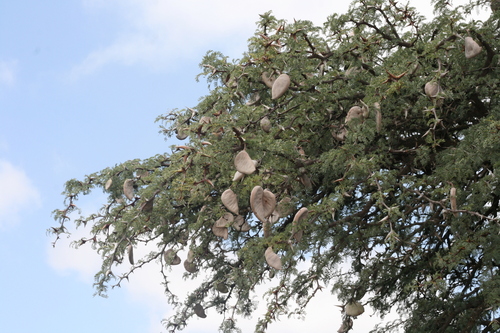
Vachellia erioloba, commonly called camel thorn, and also known as giraffe thorn, mokala tree, or Kameeldoring in Afrikaans, is still more widely referenced by its older scientific name Acacia erioloba. It is a tree species native to southern Africa, belonging to the plant family Fabaceae. It prefers to grow in deep, dry sandy soils, found across parts of South Africa, Botswana, western Zimbabwe, and Namibia, and is also native to Angola, south-west Mozambique, Zambia, and Eswatini. This tree was first formally described by Ernst Heinrich Friedrich Meyer and Johann Franz Drège in 1836, and it is a protected tree species within South Africa. Camel thorn can reach heights of up to 20 metres. It is slow-growing, very tolerant of drought, and fairly resistant to frost. Its light grey thorns reflect sunlight, and its bipinnate leaves close up during hot weather. The wood of this tree is dark reddish-brown, extremely dense, and very strong. It burns well for fuel, which has led to widespread clearing of dead camel thorn trees and felling of healthy living trees. The species produces ear-shaped pods that are a preferred food source for many herbivores, including cattle. Its seeds can be roasted and used as a substitute for coffee beans. The common name 'camel thorn' comes from the fact that giraffes (called kameelperd in Afrikaans) very commonly feed on its leaves; giraffes have specially adapted tongues and lips that let them avoid the tree's sharp thorns. The specific epithet 'erioloba' translates to 'woolly lobe', which refers to the tree's distinctive ear-shaped pods. Vachellia erioloba is famously associated with the long-running PBS wildlife program Nature, as the tree appears in the program's title sequence and is featured in its official logo.