About Vachellia drepanolobium (Harms ex Y.Sjöstedt) P.J.H.Hurter
Nomenclature and Native Range
Vachellia drepanolobium, more commonly known as Acacia drepanolobium or whistling thorn, is a swollen-thorn acacia native to East Africa.
Height
The whistling thorn grows up to 6 meters tall.
Spine Morphology
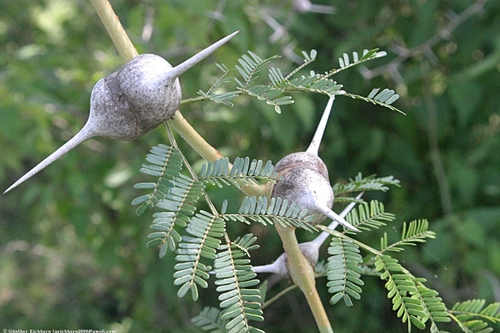
It produces a pair of straight spines at each node, and some of these spines have large bulbous bases. These swollen spines are naturally hollow, and are occupied by any one of several symbiotic ant species.
Common Name Origin
The plant's common name comes from the fact that when wind blows over bulbous spines that ants have made entry and exit holes into, the spines produce a whistling noise.
Distribution and Habitat
Whistling thorn is the dominant tree in some areas of upland East Africa, and sometimes forms a nearly monoculture woodland, especially on high-clay "black cotton" soils with impeded drainage.
Herbivory
It is browsed by giraffes and other large herbivores.
Fire Adaptation
It is apparently fire-adapted, and coppices readily after fire causes "top kill".
Wood and Craft Uses
Whistling thorn is used for fencing, tool handles, and other implements. Although its wood is usually small in diameter, it is hard and resistant to termites.
Gum and Kindling Uses
Its branches can be used for kindling, and its gum is sometimes collected and used as glue.
Fuel Source Potential
Its ability to coppice after cutting means it could be a sustainable source of fuel wood and charcoal.
Invasive Status
On the other hand, whistling thorn has also been classified as a rangeland weed and a species that causes woody plant encroachment.