About Vachellia cornigera (L.) Seigler & Ebinger
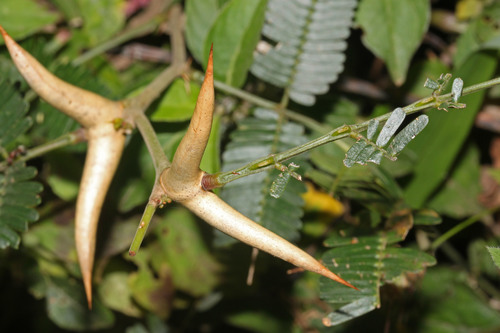
Vachellia cornigera (L.) Seigler & Ebinger, commonly called bullhorn acacia, typically grows as a tree reaching 10 meters (33 feet) in height. Its bark is gray to brown and marked with small furrows. New branch growth is reddish brown and covered in pubescence, a coating of fine small hairs. Leaves grow in an alternate arrangement, with a pair of stipular spines at the point where the leaf connects to the branch. These spines can display a wide range of colors, including brown, red, and yellow. The hollow spines serve as a home for ants that protect the plant from being eaten by herbivores. At the tips of the leaves, Beltian bodies are present; these structures are packed with fats and sugars to feed the resident ants. The tree also produces nectar rich in carbohydrates from glands located on its leaf stalks. This mutually beneficial relationship between the tree and ants is known as myrmecophily. For decorative purposes, the thorns of Vachellia cornigera are often strung together to make unique necklaces and belts. In El Salvador, the horn-shaped thorns are used as legs for small ballerina seed dolls, which are worn as decorative pins. In traditional medicine practices, the thorns of this species are used in traditional Maya acupuncture.