About Vaccinium vitis-idaea L.
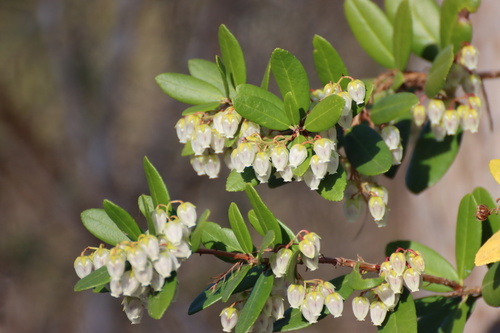
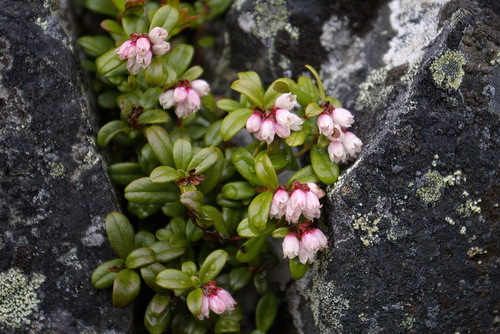
Vaccinium vitis-idaea L. spreads via underground stems to form dense clonal colonies. Slender, brittle roots grow from these underground stems. Its stems are rounded in cross-section and reach 10 to 40 cm (4 to 16 inches) in height. Leaves grow alternately, are oval-shaped, measure 5–30 mm (1⁄4–1+1⁄8 inches) long, have slightly wavy margins, and sometimes have a notched tip. The flowers are bell-shaped, range in color from white to pale pink, and are 3–8 mm (1⁄8–3⁄8 inches) long. V. vitis-idaea begins producing flowers when it is between five and ten years old. Its flowers are pollinated by multiple insect species, including Andrena lapponica and several species of bumblebee. The fruit is a red berry 6–10 mm (1⁄4–3⁄8 inches) across with an acidic taste, and it ripens from late summer to autumn. While bitter early in the growing season, the berries sweeten if they remain on the branch through winter. The cytology of this species is 2n = 24. Its fruit persists for an average of 13.4 days, contains an average of 11.2 seeds per fruit, is on average 84.9% water, and its dry weight includes 15.4% carbohydrates and 1.5% lipids. This species is native to boreal forest and Arctic tundra across the Northern Hemisphere, including Eurasia and North America. Vaccinium vitis-idaea retains its leaves throughout the entire winter, even in the coldest years, which is unusual for a broad-leaved plant. In its natural habitat, it is typically protected from severe cold by snow cover. It is extremely hardy, tolerating temperatures as low as −50 °F (−45 °C) or lower, but it grows poorly in locations with hot summers. It prefers some shade, such as that provided by a forest canopy, and constantly moist, acidic soil. It tolerates nutrient-poor soils, but cannot grow in alkaline soils. Lingonberry, the common name for Vaccinium vitis-idaea, has been commercially cultivated in the Netherlands, Germany, Sweden, Poland, the United States, and Latvia since the 1960s. Some cultivars are grown for ornamental rather than culinary value. In the United Kingdom, the Koralle Group of this species has received the Royal Horticultural Society's Award of Garden Merit. For the subspecies minus of V. vitis-idaea, the Anticosti people use its fruit to make jams and jellies. The Nihithawak Cree store the berries by freezing them outdoors through winter, mix the berries with boiled fish eggs, livers, air bladders, and fat to eat, eat the raw berries as a snack, or stew the berries with fish or meat. The Iñupiat of Nelson Island eat the berries, as do the Iñupiat of the Northern Bering Sea and Arctic regions of Alaska, and the Inuvialuit. The Haida people, Hesquiaht First Nation, Wuikinuxv, and Tsimshian all use the berries as food. In traditional medicine, V. vitis-idaea was used as an apéritif and an astringent. The Upper Tanana ate the berries or used their juice to treat minor respiratory disorders. The Nihithawak Cree use the berries of the minus subspecies to color porcupine quills, and string firm, ripe berries to wear as necklaces. The Western Canadian Inuit use the minus subspecies as a tobacco additive or substitute. In Newfoundland and Labrador, lingonberries or lingonberry extracts are frequently used in handmade soaps and candles.