About Vaccinium scoparium Leiberg
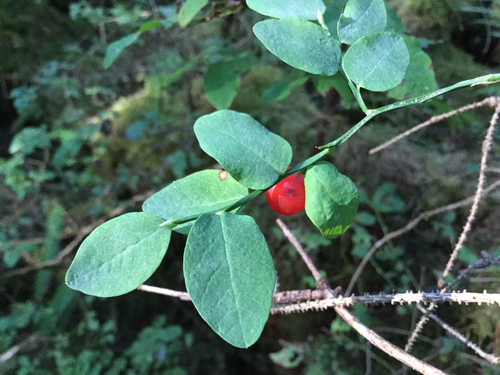
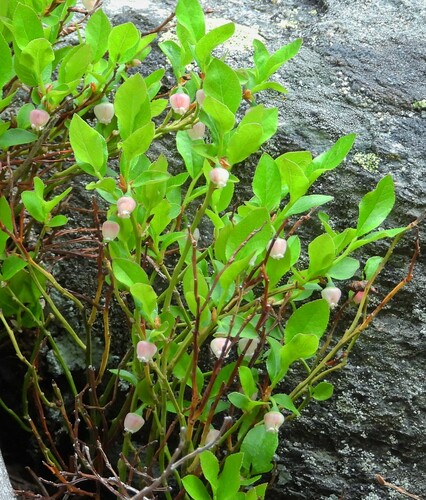
Vaccinium scoparium Leiberg is a short, bushy, rhizomatous shrub that reaches a maximum height of 0.5 meters (20 inches). It forms matted, clumpy growth and spreads outward, with stems rooting at nodes that come into contact with moist substrate. When leafless, its branches have a broom-like appearance, and new green twigs feature sharp angles. Its deciduous leaves are alternately arranged, with serrated oval blades that grow up to 1.4 centimeters (1/2 inch) long. Solitary urn-shaped pink flowers grow from leaf axils, measuring around 4 millimeters (3/16 inch) long. The plant produces a soft, bright red berry up to 6 millimeters (1/4 inch) wide, which has a tart flavor. This species is native to western North America, occurring mainly in the Rocky Mountains, Cascade Range, and Black Hills. Its range extends from British Columbia and Alberta south to far northern California, Colorado, and New Mexico, and east to South Dakota. It grows in mountain habitats including forests, meadows, and talus, in subalpine and alpine climates at elevations between 700 and 3,000 meters (2,300 to 9,800 feet). It is a common understory plant in many forested regions of the Rocky Mountains, and is common to abundant in some areas. This shrub serves as a food source for many large mammal species, including elk, mule deer, and bears, as well as many smaller animals including squirrels, foxes, skunks, and a variety of birds. The berries are edible, and were harvested as food by many Native American groups, including the Kootenay, Okanogan, and Shuswap. The berries are small and hard to collect in large quantities, so Native people likely harvested them using combs made from wood or fishbones.