About Vaccinium praestans Lamb.
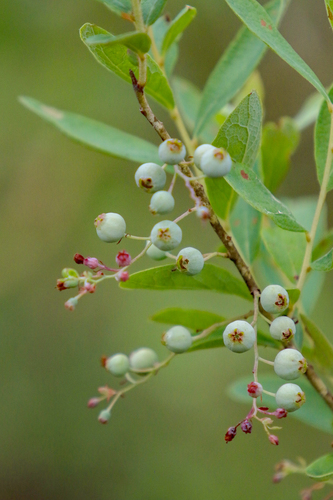
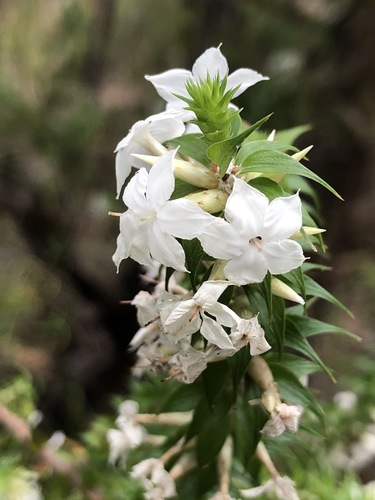
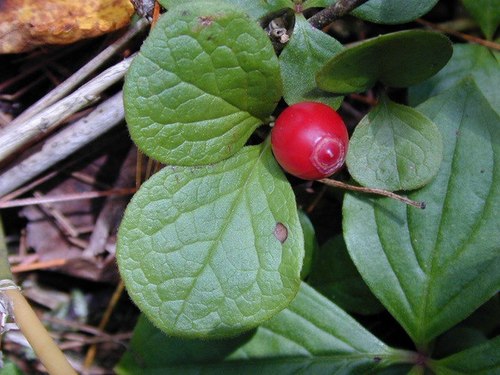
Vaccinium praestans Lamb. is a herbaceous, slow-growing perennial shrub that reaches up to 20 cm (7.9 in) tall in an average growing season. Its stem bark is yellowish-gray, and stems grow almost horizontally along the ground. It produces small leafy branches approximately 6–10 cm (2.4–3.9 in) long that extend outward from the main stem. Leaves are either obovate or orbicular at the tip, tapering to a narrower base. They are fairly thin but stiff, typically 2–6 cm long, with finely serrulate edges. Leaves change color multiple times per growing season, shifting from bright green to purple-red. Vaccinium praestans flowers from June to July. Its flowers range in color from pinkish-white to pink, with yellowish corollas, and measure 5–6 mm (0.20–0.24 in) in length. Later in summer, the plant produces bright red, delicious, juicy berries that reach 8–12 mm (0.31–0.47 in) in diameter. It is commonly called "the stinkbug berry" because it has a very strong, characteristic odor that smells like bugs. This plant is native to Kamchatka, Eastern Russia. Its distribution ranges from North America to Eastern Asia, where it grows in spruce, fir, and deciduous forests. It occurs at higher elevations and on slopes, growing in mossy bogs, marshes, and swampy woods, often growing from rotting fallen tree trunks. It is endemic to the Mountain Taiga region of Primorye, Kamchatka, Khabarovsk Region, Sakhalin, the Kuril Islands (Kunashir, Shikotan, Etorofu, Simushir, Uruppu, Keta), Honshu, and Hokkaido. Vaccinium praestans is a hardy species that can grow in harsh cold climates, but it requires shelter from strong winds, and insulation from snow and fallen leaves to protect its roots during freezing temperatures. It grows best in slightly sandy, loamy soils. It also prefers moderately moist, mesic soils with high acidity, ranging in pH from 4.5 to 6. If lime is present in the soil, the plant quickly develops chlorosis, a condition where it does not produce enough chlorophyll and its green leaves turn pale yellow to yellow-white. The plant does not tolerate root disturbance or stagnant water around its roots; it prefers moist, well-drained soils and cannot survive drought. It can grow in semi-shady conditions, but produces the most fruit when grown in full sunlight. Vaccinium praestans produces hermaphroditic flowers in June–July, which are pollinated by bees. New plants can also be grown from seed. This species is commonly cultivated in home gardens as an ornamental plant, specifically used as decorative ground cover, with the bonus of producing edible delicious berries. To grow this plant from seed, it is recommended to sow seeds in late winter in a pot, covering them only very lightly with soil. Seeds may require three months of cold exposure to stratify. Germination is very slow, and seeds can take up to a full year to sprout. Once seedlings reach 3 cm (1.2 in) tall, the pot should be placed in a lightly shaded area of a greenhouse for the seedling’s first winter. After this period, seedlings are ready to be planted into their permanent location, typically in late spring or early summer after the last expected frost. In climates with cold winters, roots must be protected from freezing; this is most commonly done by covering the plant with a pile of leaves before cold weather arrives. The berries of this plant have an ambiguous flavor that disappears when the berries are boiled. Berries can be eaten raw, and have a unique taste progression: they are initially sweet, then turn sour, and finish with a bitter, salty aftertaste. In the confectionery industry, these berries are used to make jellies, jams, marmalade, soft drinks, and pastries. Berry juice improves digestion, has tonic properties, and helps relieve symptoms of common colds and flu. The plant and its berries are used in folk medicine, where they are believed to help treat prostate hypertrophy, fever, paralysis, edema, and gout, and are used to manage hypertension due to their effectiveness in lowering blood pressure. However, the berries can cause severe allergic reactions, even from exposure to their scent alone, not just from ingestion.