About Vaccinium parvifolium Sm.
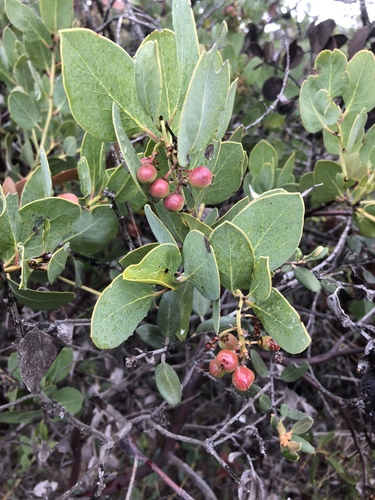
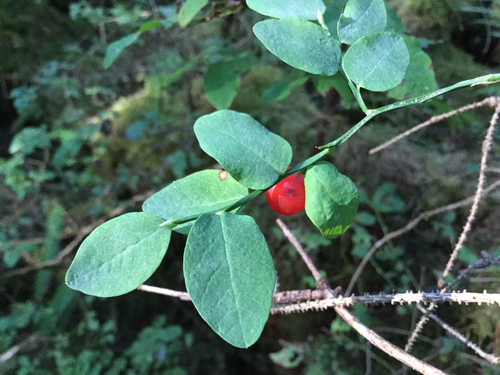
Vaccinium parvifolium Sm. is a deciduous shrub that grows up to 4 metres (13 feet) tall. It has bright green shoots with an angular cross-section. Its leaves are ovate to oblong-elliptic, 9 to 30 millimetres (1⁄4 to 1+1⁄4 inches) long and 4 to 16 mm (1⁄8 to 5⁄8 in) wide, with smooth entire margins. Nodding flowers grow singly in leaf axils; the flowers are yellow-white to pinkish, decumbent, bell-shaped, and 4 to 5 mm long. The fruit is an edible red to orange berry 6 to 10 mm (1⁄4 to 3⁄8 in) in diameter. The cytology of this species is 2n = 24.
This species is common in forests ranging from southeastern Alaska and British Columbia south through western Washington and Oregon to central California. In the Oregon Coast Range, it is the most common Vaccinium species. It grows in moist, shaded woodlands.
In its native ecology, birds, bears, and small mammals eat its berries, while deer and some livestock forage on its foliage.
This species is cultivated in the specialty horticulture trade, with limited availability as an ornamental plant for natural landscaping, native plant gardens, habitat gardens, wildlife gardens, and restoration projects. Another cultivated species that shares a similar size and habitat is the evergreen Vaccinium ovatum, also called evergreen huckleberry. Along with other western North American huckleberry species in the same genus, it is not currently grown on a large commercial agricultural scale, despite efforts to establish large-scale cultivation. It requires acidic soil with a pH between 4.5 and 6, and does not tolerate root disturbance.
The huckleberries produced by this plant can be eaten fresh, eaten dried, or processed into tea or jelly. Indigenous peoples of North America, including the Bear River Band, Karok, and Pomo tribes, have long found this plant and its fruit very useful. The bright red, acidic berries were used extensively for food throughout the year. Fresh berries were eaten in large quantities, or used as fish bait because they resemble salmon eggs. Berries were also dried for later use; dried berries were stewed to make sauces, or mixed with salmon roe and oil to serve at winter feasts. The bark and leaves of the plant can be brewed as a bitter tea or smoked to use as a cold remedy. Branches were used as brooms, and twigs were used to fasten western skunk cabbage leaves into berry baskets.