About Vaccinium myrsinites Lam.
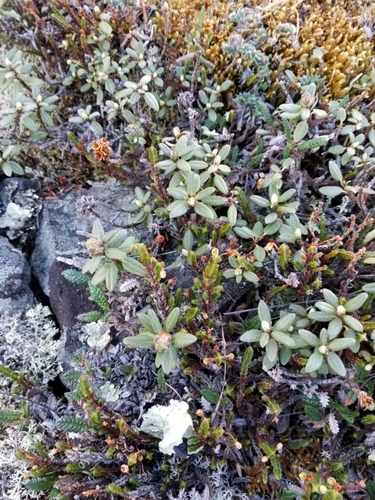
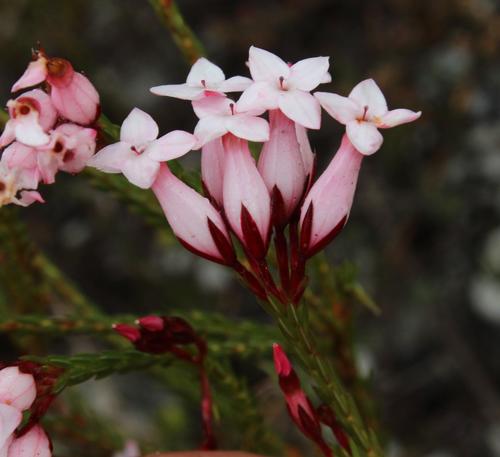
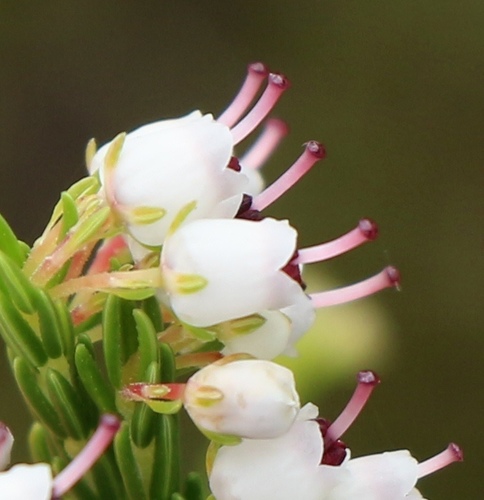
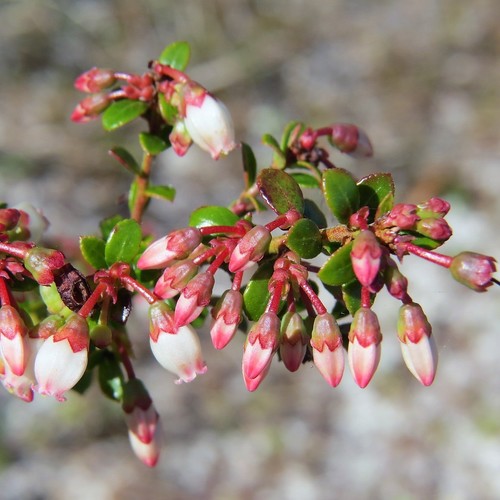
Vaccinium myrsinites Lam. is an erect, branching shrub that reaches a maximum height of 1 meter (40 inches). It is rhizomatous and can form very large colonies; colonies measuring 1 kilometer (0.63 miles) across and over 1,000 years old have been observed. It is generally evergreen, though some forms are deciduous. Its stems bear angular green twigs. The leathery leaves are green or grayish green, oval in shape, up to roughly 1 centimeter (0.4 inches) long, with smooth or vaguely toothed edges. The leaf undersides are glandular. The flowers are urn-shaped or cylindrical, white to pink or red-tinged, borne in clusters of up to 8, and may be nearly 1 centimeter long. The fruit is a black or waxy blue berry up to 8 or 9 millimeters in length, containing several seeds. The cytology of this species is 2n = 48. This species grows in multiple habitat types across the southeastern United States, including prairies, pine barrens, bog margins, flatwoods, Florida scrub, palmetto communities, and rosemary balds. It also grows in disturbed areas, clearcuts, and fallow cultivated areas. Common associated plants include scrub palmetto, netted pawpaw, scrubclover, dodder, Florida blazingstar, scrub mint, tree sparkleberry, saw palmetto, Lyonia, dwarf huckleberry, inkberry, bracken fern, several oaks, and many pine species. The best growing sites for this plant are dry, sandy stretches of acidic soils in full sunlight. Like many southeastern scrub species, Vaccinium myrsinites is fire-adapted. It can recover from fire by sprouting from its rhizome, which is also how it forms vast colonies of cloned individuals. The plant also reproduces sexually via seed, and seeds are dispersed by animals that enjoy eating its fruits. Vaccinium myrsinites is thought to be a hybrid of two other blueberry species: small cluster blueberry and Darrow's evergreen blueberry. Individual plants may resemble one or the other parent species: the "darrowoid" form is more common in coastal Florida, while the "tenneloid" form occurs in southern Georgia and northern Florida. This species also hybridizes with many other blueberry species. The Seminole people used V. myrsinites as food, and for a variety of ceremonial and medicinal purposes, including treatment of "hog sickness", or unconsciousness.