About Vaccinium macrocarpon Aiton
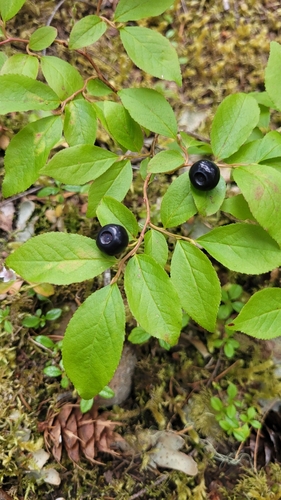
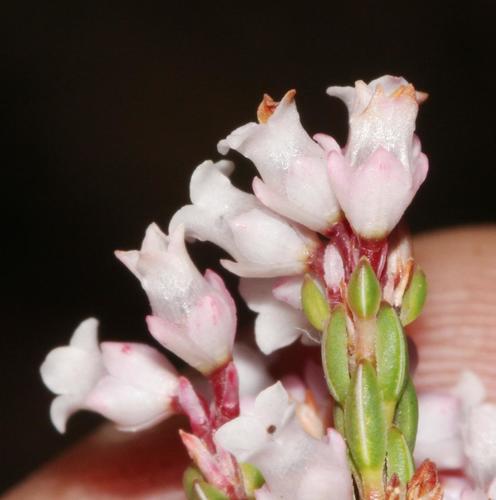
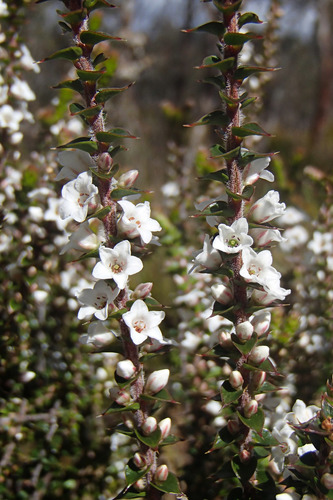
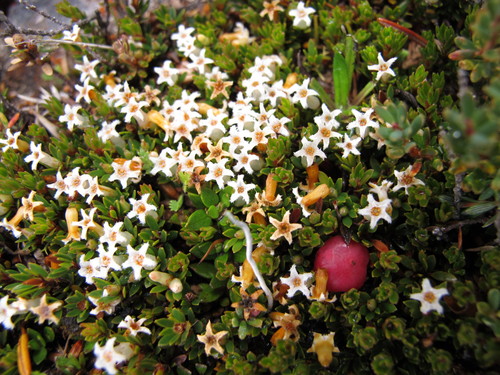
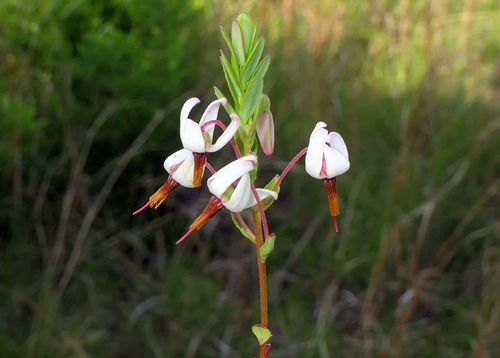
Vaccinium macrocarpon Aiton is a perennial shrub that typically has an ascending growth habit: it trails along the ground surface for some distance before curving upward. Its leaf blades are glaucous on the lower surface and green on the upper surface. They measure 1–2 centimetres (1⁄2–3⁄4 in) long, with a shape ranging from narrowly elliptic to elliptic, and are rarely oblong. Its slender, nodding pedicels grow to 2 to 3 cm (3⁄4 to 1+1⁄4 in) long. This species produces white or pink four-petaled flowers, which are followed by sour-tasting red or pink berries 9–14 millimetres (3⁄8–1⁄2 in) across.
This plant is native to central and eastern Canada, from Ontario to Newfoundland, and the northeastern and north-central United States, including the Northeast, the Great Lakes Region, and the Appalachians as far south as North Carolina and Tennessee. It is also naturalized in parts of Europe, as well as scattered locations in western North America, including British Columbia in western Canada and the West Coast of the western United States.
The berries of Vaccinium macrocarpon are edible, and the species is grown commercially as a cash crop. Most commercial cranberry cultivation takes place in wetland soils made up of alternating layers of organic matter and sand. Modern cranberry harvesting involves temporarily flooding fields, shaking berries loose from the plant, and collecting the floating berries. Common products made from the berries include sauce, jelly, juice, and dried fruit. There is some evidence indicating that the berries or their juice may help treat or prevent certain urinary tract infections, but this evidence is not conclusive, so cranberry products cannot replace standard medical management. Some research suggests cranberries may suppress asymptomatic colonization by Helicobacter pylori, though they are less effective than antibiotic therapy for treating symptomatic patients.