About Vaccinium L.
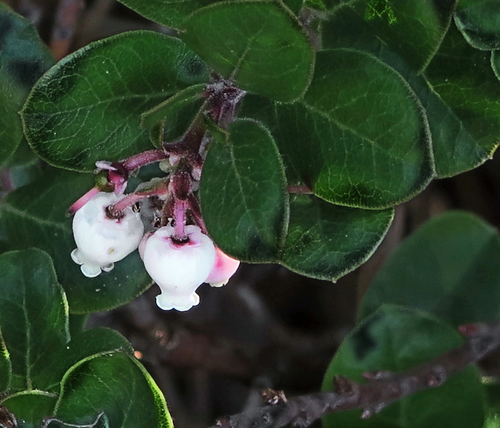
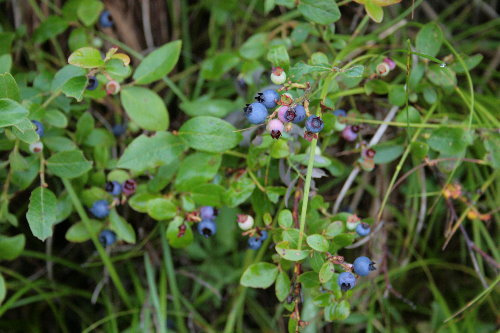
Vaccinium angustifolium, commonly lowbush blueberry, is a low spreading deciduous shrub that reaches 5 to 60 centimetres (2 to 23+1⁄2 inches) in height. Its rhizomes can remain dormant for up to 100 years, and will sprout when given sufficient sunlight, soil moisture, and oxygen. In summer, its leaves are glossy blue-green, and they turn a range of red shades in autumn. Leaves are broad to elliptical in shape, and brownish red buds develop in stem axils. Flowers are white or pink, bell-shaped, and measure 4 to 6 millimetres (1⁄8 to 1⁄4 inch) long. The fruit is a small, sweet dark blue to black berry that contains high levels of antioxidants and flavonoids. Healthy stems may bear several buds, and each opening bud can produce multiple blossoms. A fully covered blueberry field can hold up to 150 million blossoms per acre. The chromosome number for this species is 2n = 48. Lowbush blueberry is native to central and eastern Canada, ranging from Manitoba to Newfoundland, as well as north-central and eastern United States, where it grows as far south as the Great Smoky Mountains and west to the Great Lakes region. In its native habitat, the plant grows in open conifer woods, old fields, and sandy or rocky balds. Ice Age glacier ice sculpted the Maine landscape, and created some of the most productive habitats for V. angustifolium. This species is fire-tolerant, and its population often increases in an area after a forest fire. It grows best in wooded areas, old abandoned farmyards, or open areas with well-drained acidic soils. In some regions, it forms natural blueberry barrens, where it is practically the only species covering large expanses of land. Many animals feed on the fruit and foliage of lowbush blueberry, including black bears, raccoons, foxes, white-tailed deer, and birds. Its foliage is also popular food for caterpillars. It acts as a larval host for a wide range of moth and butterfly species: the pale tiger moth, the peppered moth, the chain-dotted geometer, the saw-wing moth, the blueberry gray moth, the mousy angle moth, Caloptilia vacciniella, Andromeda underwing, the shadowy arches, the two-spot dart, the dingy cutworm moth, the speckled cutworm, the decorated owlet, the pirate looper, Norman's dart, the gray swordgrass moth, the pink-edged sulphur butterfly, the pawpaw sphinx moth, and the blueberry leaftier moth. During the fruit-bearing harvest year, commercial blueberry growers rent honey bee hives to place in their fields for pollination. Hives are placed at densities ranging from 1 to 8 hives per acre. They are added to fields when 10-20% of blooms are open, to give bees enough forage and discourage them from foraging elsewhere. On average, hives are left in blueberry fields for 2 weeks, to allow pollination of all the field's clones, which bloom at different times across this two-week window. Some growers also use bumblebees to achieve maximum pollination. Bumblebees will fly in colder and wetter weather than honey bees, and they pollinate blueberry flowers differently: they can sonicate flowers to release pollen from deep inside poricidal anthers, a process called buzz pollination. Blueberry growers also rely on many wild bees for pollination, including solitary bees such as Andrena carlini and Colletes inaequalis. Vaccinium angustifolium follows a two-year production cycle. The first year is the vegetative year, and the second is the fruit-bearing year. To get a harvest every year, most farmers split their land so half the crop is in the vegetative year while the other half is in the fruit-bearing year. Traditionally, blueberry growers burn their fields every few years to remove unwanted shrubs and fertilize the soil. In Acadian French, a blueberry field is called a brûlis (from brûlé meaning 'burnt') after this still-used cultivation technique.