About Vaccinium boreale I.V.Hall & Aalders
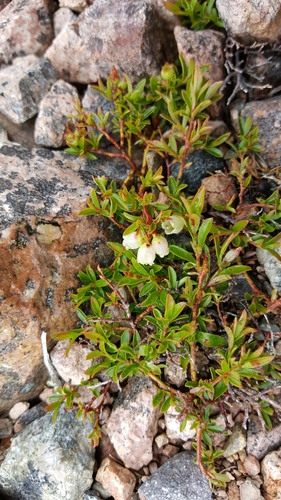
Vaccinium boreale I.V.Hall & Aalders, commonly known as northern blueberry, is a lowbush blueberry that grows as a small shrub reaching up to 9 centimetres (3+1⁄2 inches) tall, and forms dense colonies made up of many individual plants. Its twigs are green, angled, and bear lines of hairs. This species has deciduous leaves that are narrowly elliptic, growing up to 21 millimetres (7⁄8 of an inch) long, with toothed margins. Its flowers are white, growing up to 4 mm (3⁄16 of an inch) long, and it produces blue berries that reach up to 5 mm across. The chromosome count for this species is 2n = 24. Vaccinium boreale is native to northeastern United States and eastern Canada. It has been recorded in Québec, New Brunswick, Nova Scotia, Newfoundland and Labrador, Maine, New Hampshire, Vermont, and New York State. It grows in arctic or alpine tundra, rocky uplands, and open conifer forests, at elevations up to 2,000 metres (6,600 feet). Lowbush blueberries, sometimes called "wild blueberries", are typically not directly planted by farmers. Instead, they are managed and harvested wild from managed berry fields called "barrens".