About Vaccinium arboreum Marshall
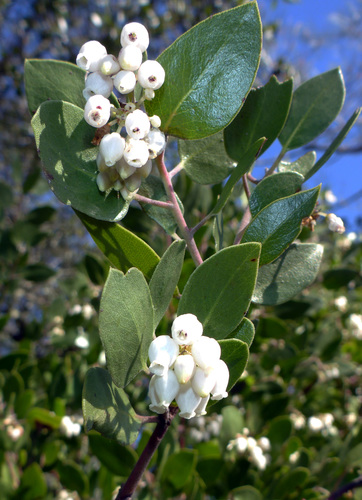
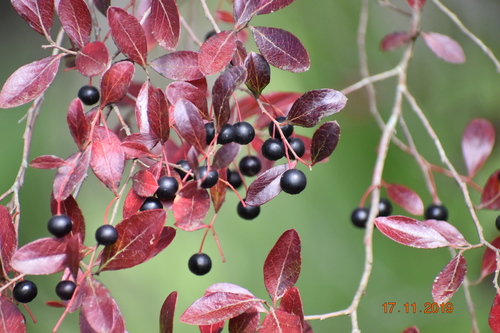
Vaccinium arboreum Marshall, commonly called sparkleberry, is typically a shrub, and rarely grows as a small tree. It reaches 3–5 metres (10–16+1⁄2 ft) in height, and can grow exceptionally to 9 m (30 ft) tall, with a diameter at breast height of up to 35 centimetres (14 in). Its leaves are evergreen in the southern portion of the species' range, and deciduous further north where winters are colder. The leaves are oval-elliptic with an acute apex, measuring 3–7 cm (1+1⁄4–2+3⁄4 in) long and 2–4 cm broad, with a smooth or very finely toothed margin. Its flowers are white, bell-shaped, and 3–4 millimetres (1⁄8–3⁄16 in) in diameter, with a five-lobed corolla, and they are produced in racemes up to 5 cm (2 in) long. The fruit is a round, dry berry about 6 mm (1⁄4 in) in diameter. It is green when unripe and black when fully ripe, with a bitter, tough texture. The cytology of this species is 2n = 24. Sparkleberry occurs in the United States, ranging from southern Virginia west to southeastern Nebraska, south to Florida and eastern Texas, and north to Illinois. It grows in both sandy and rocky habitats, including dry woods, and can also grow across a variety of moist sites such as wet bottomlands and along creek banks. The berries of this species are eaten by a wide range of wildlife. Because it is relatively hardier than many other Vaccinium species, V. arboreum has been studied as a potential rootstock. This use would allow expanding the range of blueberry cultivation to less acidic soils with a pH greater than 6.0, and help reduce the severity of bacterial leaf scorch.