About Vacciniina optilete (Knoch, 1781)
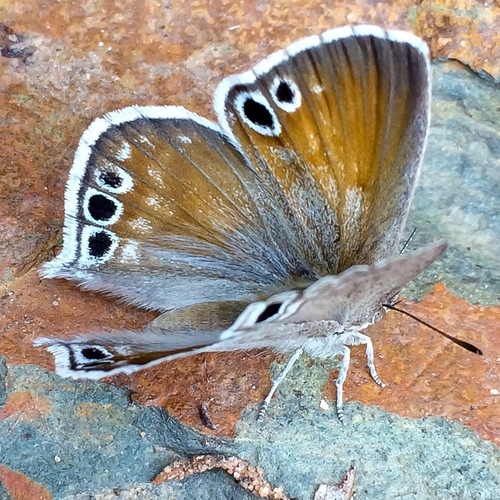
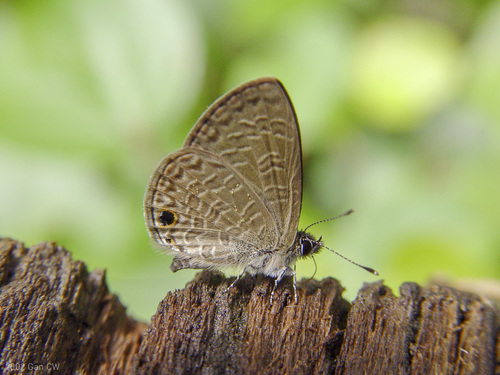
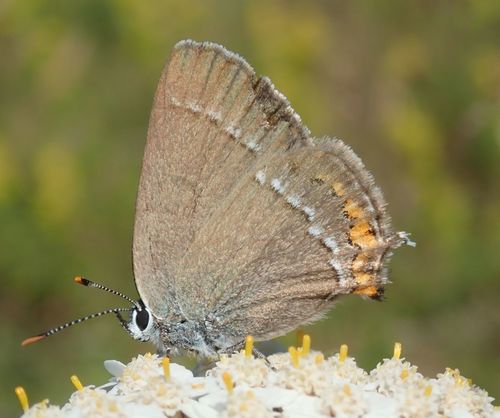
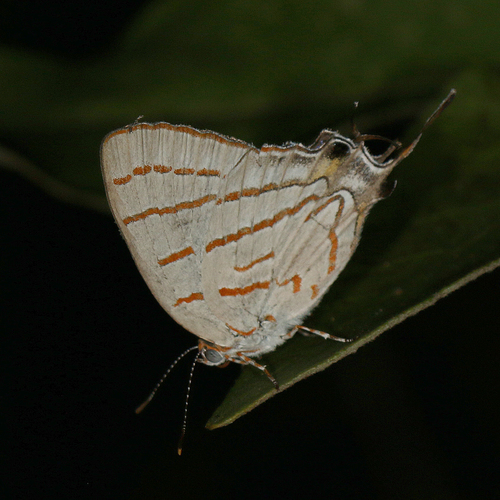
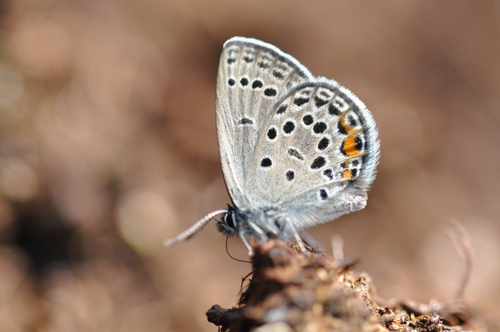
This is a description of Vacciniina optilete (Knoch, 1781), originally referenced as L. optilete Knoch from Seitz. The author notes that this species does not fit well within its current placement in the Lycaena group in terms of both traits and habits, and would be better positioned in a later group than its location in Staudinger-Rebel's Catalogue. Both of its wings are very broad with strongly rounded outer margins. Males have a very dull dark violet-blue upper wing surface, sometimes with a broader black margin, and sometimes without. In females, only the basal half of the upperside is dusted with glossy blue scales. The underside of the wings is dirty dust-grey; the ocelli are very large and often distorted. Only the anal area of the hindwing underside bears orange spots before the margin, and these spots are separated from the margin by two large round dots with metallic centres. This species occurs more widely in the North, found across Central and Northern Europe as far as Scandinavia and the Baltic provinces. It is sporadic, inhabits moors, and is also present in the Alps in damp larch woods, being locally abundant. A smaller form of the species appears from time to time, especially in the high Alps (Valais, Engadine), Lapland, North Finland, and North Siberia. This smaller form is cyparissus Hbn. Its underside is a purer dust-grey, the black spots are smaller, more compact, sharper, more regularly arranged, and less distorted or widened than in the nominal form. The anal red marking on the hindwing underside is usually reduced to one or two sharply defined spots, rather than being smear-like or dull as in true optilete. The two forms are connected not only by Amur-region specimens named sibirica Stgr., but also by transitional forms frequently found in West Siberia and Europe that sometimes approach one form and sometimes the other. Alpine cyparissus specimens cannot be separated from northern cyparissus, because optilete also flies in the Alps and cyparissus occurs in the North. That said, individuals from the High Alps and High North tend to lean more toward cyparissus, while the form that flies on Sphagnum-swamps of warmer plains, particularly in North Germany, is the most typical optilete. In the Ural, a form with a black-grey underside ground colour flies, and this is uralensis Courv. i. l. The aberration ab. subtusradiata Favre covers specimens in which distortion of the ocelli has led to the appearance of rays. The larva is pale green, densely covered with minute silky reddish yellow hair, and marked with a light-yellow lateral stripe bordered by black; it develops until June on Vaccinium myrtillus. The pupa is rounded and obtuse, with small yellowish red hairs dotted on its anterior part, and is green with yellow abdominal segments. Adult butterflies are on wing from the end of June into September, are locally plentiful, and occur on moors and in woods of tall trees, where it is usually the only blue butterfly found. The butterflies mostly stay in more open spots that have a central bush, from which males make short flights. In the Alps, they are often found at small rills, sometimes occurring in large numbers at Zermatt and Eiffelhaus, and often in the company of other Lycaenas. Due to their broad wings, their flight is a little different from that of other blues, and recalls the flight of Cyaniris argiolus, but it flies low. In Bucovina, the species has been collected at the end of June and in September, but this is not definite proof that there are two broods.