About Utricularia inflata Walter
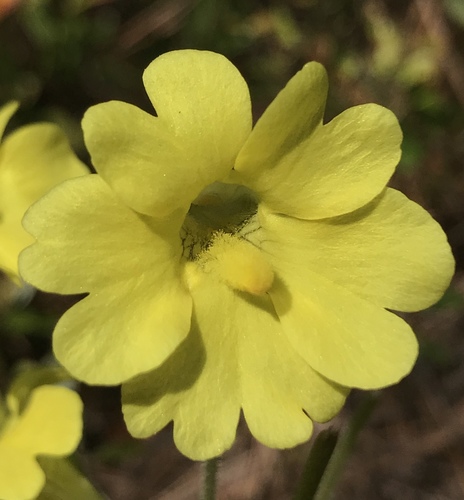
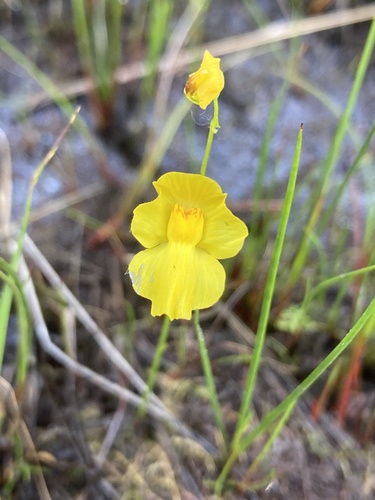
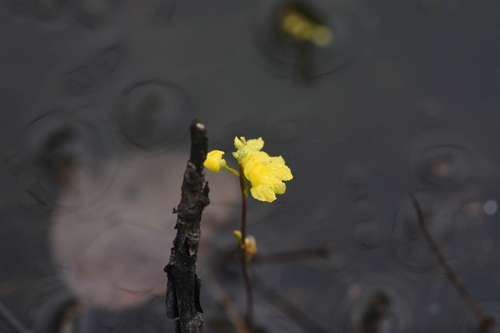
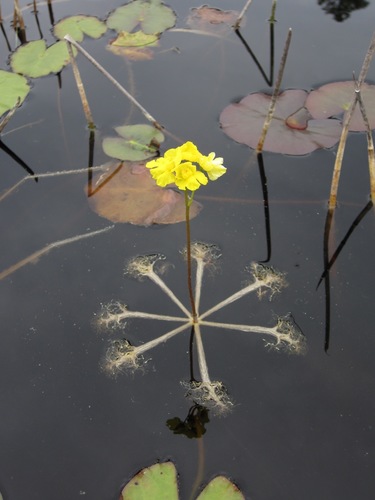
Utricularia inflata Walter is one of the larger suspended aquatic carnivorous plants in the genus Utricularia. Like all aquatic Utricularia species, it has no true roots or leaves. Its main vegetative structure consists of glabrous, thread-like stolons, which reach up to one meter or more in length but are only 1–2 mm thick, with 1–5 cm between branched divisions. Occasionally, stolons produce floating air shoots at the water surface and tuber-like structures in the substrate. The tiny, thread-like leaf-like structures are additional branches from the main stolon, and are not true leaves—this terminology is disputed among experts. These structures are numerous, 2–18 cm long, and originate from the stolon base as two unequal primary segments, which then divide extensively into smaller segments. Stalked, ovoid traps 1–3 mm long grow in large numbers on these smaller leaf segments. As a perennial species in its native range, U. inflata flowers from January through June. When flowering, it produces its most visible morphological feature: a floating, spoke-like whorl of spongy structures at the water surface that supports the inflorescence, commonly called a "float". This float typically has 6 to 8 spokes (ranging from 5 to 10), each 3–10 cm long and up to 8 mm wide. The apical half of each spoke bears numerous dichotomously branched leaf-like segments, which may also carry some traps. Erect inflorescences 20–50 cm long grow from the center of the floating whorl; they are usually solitary, with very few scapes per whorl. A single plant may produce multiple whorls and inflorescences, which are typically spaced far apart. Inflorescences bear 9 to 14 flowers (sometimes 4 to 17), with unequal calyx lobes 3–5 mm long. The entire corolla is 2–2.5 cm long, bright yellow, with brown veins on the spur and brown markings on the lower corolla lobe. The most common form of this species has a diploid chromosome number of 2n = 18, while larger tetraploid populations have 2n = 36. Peter Taylor called the larger tetraploid form a "race", which can grow up to twice the size of the typical diploid form; populations of this tetraploid race are found in Florida. Utricularia inflata is native to the southeastern United States. Peter Taylor's 1989 taxonomic monograph recorded native populations in Alabama, Arkansas, Delaware, Florida, Georgia, Kentucky, Louisiana, New Jersey, North Carolina, South Carolina, Tennessee, Texas, and Virginia. In addition to these states, the United States Department of Agriculture's online PLANTS database recognizes populations in Connecticut, Maryland, Michigan, Mississippi, New York, Oklahoma, and Pennsylvania. Maryland, Michigan, and New York have classified U. inflata as endangered or threatened, while Tennessee lists it as a species of special concern. It lives in aquatic habitats including lakes, ditches, and swamps, in shallow to deep water at low altitudes. Utricularia inflata is cultivated by carnivorous plant enthusiasts among other Utricularia species. Because it does not require a dormancy period and grows quickly, it is one of the easier suspended aquatic Utricularia species to cultivate. Barry Rice, author of Growing Carnivorous Plants, states that this is the easiest suspended aquatic Utricularia he has grown. Rice also notes that U. inflata has been used to support cultivation of particularly sensitive, difficult species such as Aldrovanda vesiculosa, which does not tolerate high nutrient concentrations. When grown together, U. inflata grows rapidly in the presence of higher nutrients, creating the low-nutrient conditions that A. vesiculosa requires to thrive. Records from Barry Rice, the Washington Department of Ecology, and the United States Geological Survey's Nonindigenous Aquatic Species information resource all note that cultivation is the most likely source of U. inflata introduction to Horseshoe Lake in Washington. Spread between lakes in Washington is probably caused by waterfowl carrying plant fragments or propagules as they move between water bodies.