About Utricularia gibba L.
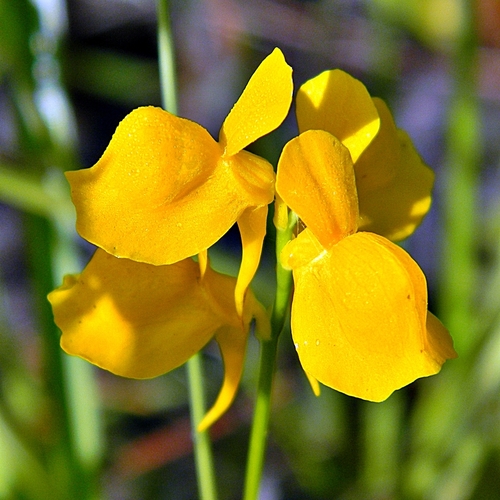
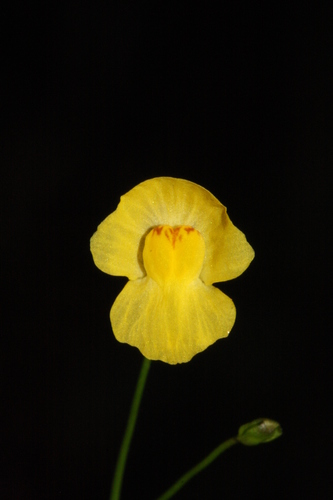
Utricularia gibba L. is an aquatic carnivorous plant in the Utricularia (bladderwort) genus. Its specific epithet "gibba" is Latin for "hump" or "swelling", which refers to the inflated base of the corolla's lower lip. This is a small to medium-sized aquatic species that can either root to substrate in shallow water or float freely in the water column, though it typically produces more flowers when anchored to substrate in shallow water. It forms mats of criss-crossing, branching, thread-like stolons, each reaching approximately 20 cm (8 in) or longer in length, and 0.2–1 mm thick. Numerous structures often described as leaves or leaf-like organs are scattered along the length of these stolons; distinguishing true leaves in this species' reduced morphology is difficult. These structures are 0.5–1.5 cm (0.2–0.6 in) long, with a short dichotomous branching pattern toward the tip that produces between one and eight branches, usually no more than four. Some of the distal branches on these leaf-like structures are replaced by bladder traps. The ovoid traps attach to leaf-like structures via a short stalk, and each measures 1–2.5 mm long. Each trap has two primary bristle-shaped branched appendages at its top, with smaller appendages surrounding the trap entrance. These appendages act as a trigger to activate the trap, which sucks in prey that touches it into the bladder for digestion. Erect inflorescences typically emerge from the water to around 20 cm (8 in) tall, though they may sometimes remain fully submerged and produce cleistogamous (closed, self-pollinating) flowers. A single inflorescence can produce between one and twelve flowers, though two to six flowers per inflorescence is the most common. Individual flowers are yellow, often marked with reddish-brown veins, and divided into two lips. The upper lip is nearly circular with a weak division into three lobes, while the lower lip is slightly smaller, also circular, and has a rounded, bilobed swelling at its center. The spur is narrowly conical or cylindrical, curves downward below the flower, and ranges in length from just shorter than the lower lip to noticeably longer. Utricularia gibba flowers year-round when growing conditions are suitable. Across its large native distribution, corolla size varies from 0.8 to 1.5 cm (0.3 to 0.6 in). The diploid chromosome number for U. gibba is 2n = 28. Utricularia gibba has an extensive geographic range. It is native to the eastern United States, southeastern Canada, Central America, the Caribbean, the western Mediterranean, Southern Africa, and southern India. It is classified as an invasive species in Hawaiʻi, Australia, Japan, Brazil, New Zealand, Singapore, Serbia, Hungary, and the United Kingdom. This species grows in ponds, lakes, shallow water in ditches, pools, bogs, swamps, and marshes with still or slow-moving water. It can occasionally grow in deep water, but will not flower unless inflorescences are supported near the water surface by living or dead vegetation. The waters it inhabits are generally low in available phosphorus and nitrogen. In cultivation, Utricularia gibba is known as one of the easier aquatic bladderworts to grow, and is often described as a weed in cultivation settings. In his 1998 book *The Savage Garden: Cultivating Carnivorous Plants*, Peter D'Amato noted that successful cultivation can be achieved by floating U. gibba in a small cup or bowl, growing it in waterlogged peat, or keeping it in the water-filled trays of other cultivated plants. It can also be grown easily in aquaria.