About Utetheisa pulchella Linnaeus, 1758
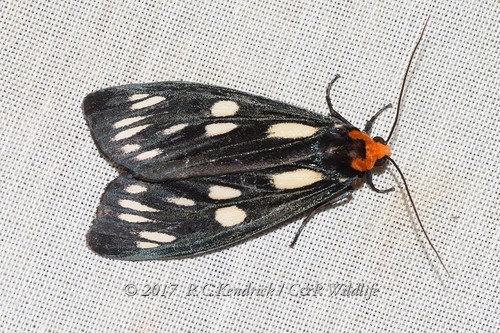
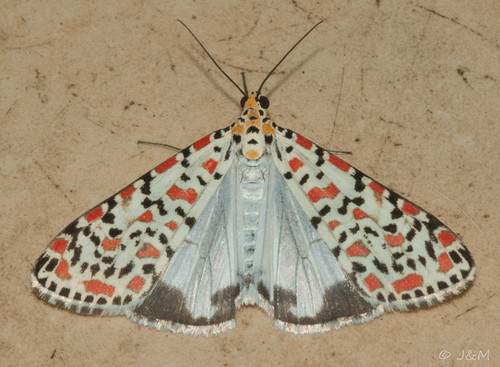
Utetheisa pulchella (Linnaeus, 1758) has a wingspan that reaches 29–42 mm. Its forewings are narrow, and are colored white or cream, with a variable pattern of many small black spots positioned between larger bright red spots. In some individuals, these red spots merge into transverse bands. The hindwings are wide and white, with an irregular black border along the outer edge, plus two black markings in the center of the cell. The head and thorax range in color from cream to buff yellow, and carry the same pattern seen on the wings. The antennae are long and monofiliform. The abdomen is smooth, with a white base color. Caterpillars of this species are warty, and dark brown or greyish in overall color. They have tufts of greyish hairs, an orange crossline on each body segment, a broad whitish line running along the back, and two additional white lateral lines. This is a common, widespread species. It can be found across most of Europe as a migrant, throughout the entire Afrotropical realm, in North Africa, the Near East, Central Asia, and the western Indomalayan realm; it is not known to occur east of Myanmar. In the United Kingdom, it is only a sporadic migrant. These moths live in dry open habitats including meadows, shrublands, grasslands, and parks.