About Utetheisa ornatrix Linnaeus, 1758
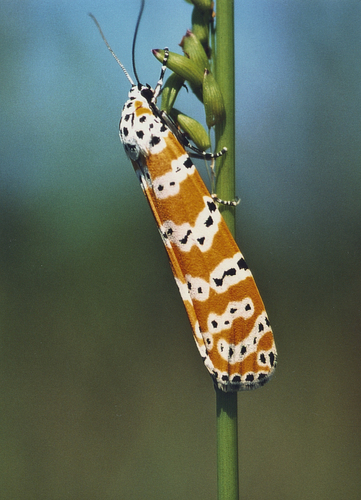
Utetheisa ornatrix, first described by Linnaeus in 1758, is a moth of the subfamily Arctiinae. It has several common names: ornate bella moth, ornate moth, bella moth, and rattlebox moth. This moth has aposematic coloration, with wing colors ranging from pink, red, orange, and yellow to white, marked with black patterns that vary between individuals. Its wingspan measures 33 to 46 mm. Unlike most moths, the bella moth is active during the day (diurnal). Historically, the population of this moth found in temperate eastern North America was classified as a separate species, Utetheisa bella, but it is now treated as part of the single species Utetheisa ornatrix. Its larvae usually feed on Crotalaria species, which contain poisonous alkaloids that make the larvae unpalatable to most predators. If larvae have an alkaloid deficiency, they may prey on other bella moth larvae to make up for the deficit. Utetheisa ornatrix has complex mating strategies, so it is an excellent model organism for studying sexual selection. Females mate multiple times, and receive nuptial gifts in the form of spermatophores from many males; these spermatophores contain sperm, nutrients, and alkaloid compounds. Females choose males based on the intensity of the courtship pheromone hydroxydanaidal, and perform sperm selection after mating with multiple different males. This species is native to the Americas. Its distribution extends from the southeastern United States down through Mexico, Central America, and into South America as far as southeastern Brazil. Within the southeastern United States, its range stretches from Connecticut west to southeastern Nebraska, and south to southern New Mexico and Florida. It is more common in the more tropical southern parts of this range, which matches the greater availability of its host plant in these southern regions.