About Usnocetraria oakesiana (Tuck.) M.J.Lai & J.C.Wei
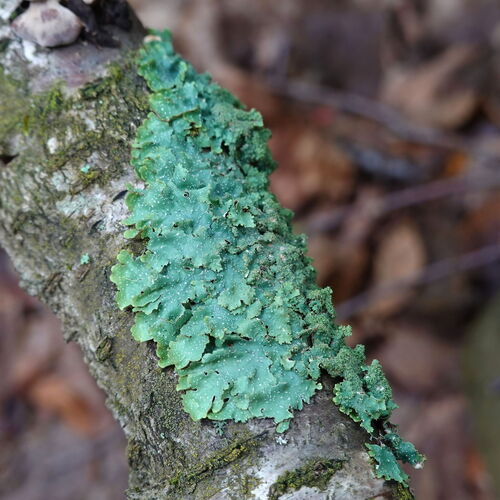
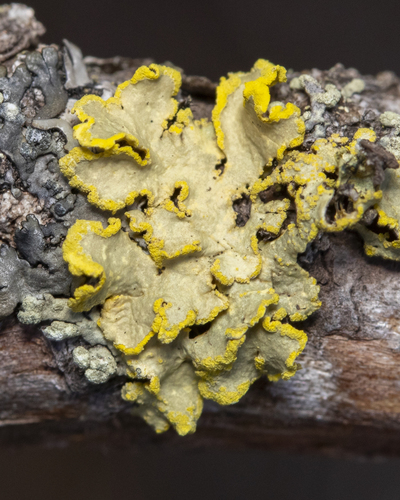
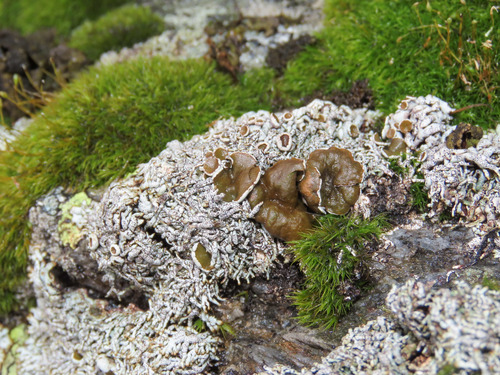
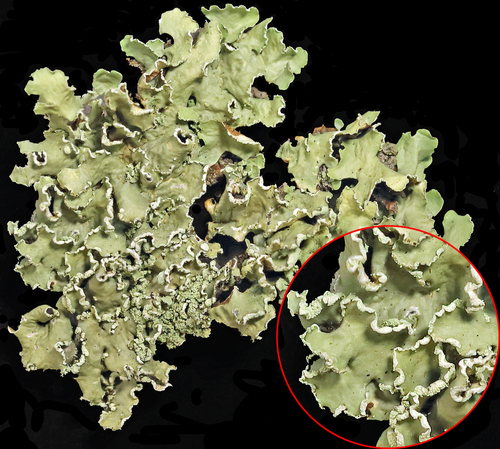
Usnocetraria oakesiana is a foliose lichen, which means it has a leafy appearance and a dorsiventral structure where the upper and lower surfaces are distinctly different. Its thallus, the main body of the lichen, attaches tightly to its substrate and forms irregular patches. The lobes of the lichen are elongated, typically between 4 and 10 mm (0.16 to 0.39 inches) wide. They are usually concave with raised edges, and these edges are covered in soredia – powdery reproductive propagules made of both algal and fungal cells. The upper surface of the lichen is yellowish-green, smooth, and somewhat glossy, while the lower surface ranges from tan to pale brown. The lower surface also has scattered rhizines, which are root-like structures that anchor the lichen to its substrate. These rhizines are either simple or forked, pale brown in color, and the species does not have pseudocyphellae, the tiny surface pores found in some other lichen species. Both the upper and lower outer layers (cortices) of the lichen are paraplectenchymatous, meaning they are constructed from tightly packed cells with thick walls; these cortical layers are relatively thin. The inner layer of the lichen, called the medulla, is white. Apothecia, the spore-producing fruiting bodies of this species, are extremely rare. When they do occur, they are zeorine, meaning they have both thalline and proper margins, typically grow near lobe edges, and can reach up to 7 mm across with a pale brown disc. The spore-bearing asci inside the apothecia are club-shaped (clavate) and usually hold eight spores each. The ascospores are single-celled, transparent (hyaline), nearly spherical, and about 5 μm in diameter. Pycnidia, small flask-shaped structures that produce asexual spores, are also rare in this species. They are black, grow at lobe edges, and protrude slightly from the lichen surface. The asexual conidia spores produced by pycnidia are somewhat flask-shaped (sublageniform), and measure 7–12 μm long by 0.8–2 μm wide. Usnocetraria oakesiana has a chlorococcoid photobiont, so its symbiotic algal partner is a type of green algae with small, round cells. This lichen shows no reaction to standard chemical spot tests (results are K−, C−, KC−, P−), but its upper cortex contains usnic acid – a compound that often produces the lichen’s yellowish color – while its medulla contains the secondary lichen metabolites caperatic acid, lichesterinic acid, and protolichesterinic acid. Usnocetraria oakesiana is found in Asia, Europe, and North America. It grows on bark, wood, and rock, and typically favors older, shaded forests.