About Usnea florida (L.) F.H.Wigg.
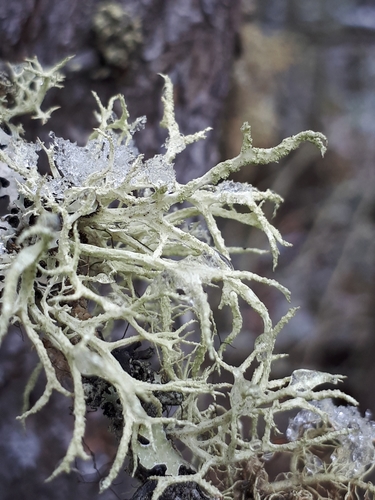
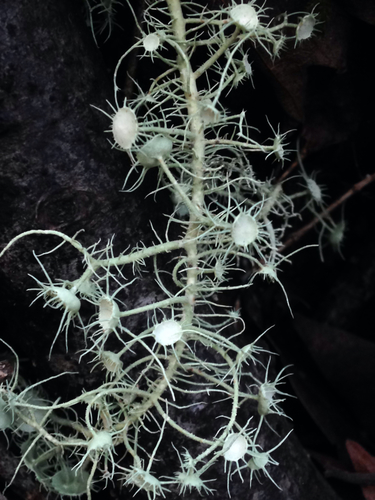
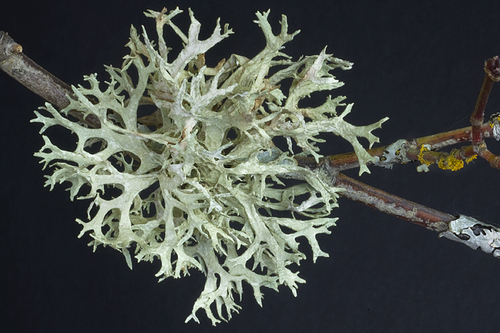
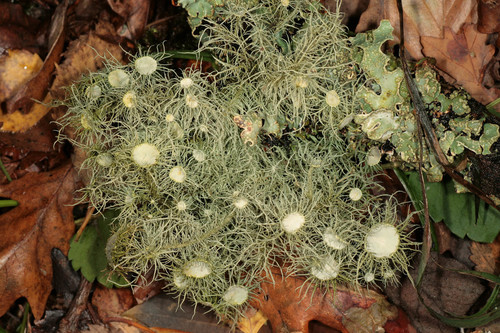
Usnea florida (L.) F.H.Wigg. is a shrubby, fruticose, upright lichen. It typically grows 2 to 5 cm tall, and occasionally reaches up to 10 cm in height, often forming compact, bush-like clusters. The main branches of its thallus—the lichen’s vegetative body—are relatively slender, around 1 mm in diameter, and are frequently curved or irregularly twisted. These branches may bear subtle, ring-like markings called annulations. Thinner secondary branches are often distinctly contorted, which gives the lichen a tangled overall appearance. The entire thallus is grey-green, and gradually darkens to black near its base. Primary branches are covered in numerous short, densely packed tiny projections called papillae, which create a slightly roughened texture. Longer, hair-like structures called fibrils also extend outward from the branches; these typically grow up to 1 cm long, and usually emerge at right angles from the branches before curving or curling gently. This adds to the species’ characteristic tufted appearance. Reproductive structures called apothecia commonly develop at the tips of main branches and larger side branches. These apothecia start as concave discs 0.5 to 1 cm across, and flatten as they mature. The surface of these reproductive discs ranges from smooth to somewhat wrinkled. Each disc is prominently surrounded by many slender, fibril-like extensions that often branch themselves, growing up to 5 mm long, giving the apothecia a fringed look. Microscopically, the ascospores (spores) of Usnea florida are oval or ellipsoid, typically measuring 8.5 to 11 micrometres (μm) long and 5.5 to 7 μm wide. Chemically, the medulla—the innermost tissue layer of the thallus—has distinctive reactions to chemical spot test reagents: it turns yellow when potassium hydroxide solution (K) is applied, and orange when exposed to p-phenylenediamine (Pd). These reactions indicate the presence of specific secondary lichen metabolites: primarily thamnolic acid, and occasionally alectorialic acid, which is found mainly in the apothecia. In the United Kingdom, Usnea florida grows predominantly on smaller branches and twigs in the upper canopy of broad-leaved trees, and rarely occurs on tree trunks. It occasionally grows on shrubs, wooden fences, or fence posts. It grows best in open, light-rich environments. While it is locally common in some regions, its populations are declining, a change that may be caused by elevated atmospheric ammonia concentrations. In the UK, its range is centered mainly on southern and western Britain, with isolated scarce occurrences in southern Scotland. Usnea florida has been confirmed to occur in Bieszczady National Park in the Polish Eastern Carpathians, where it grows epiphytically on tree bark at elevations between 800 and 880 metres. Though it was historically recorded from additional nearby localities, these older records have not been confirmed by modern surveys. In Italy, U. florida is adapted to cooler climates, and typically grows in mountain forests that experience frequent fog. It mostly grows on small branches and twigs, and does particularly well in the upper montane and subalpine zones. Its Italian distribution extends across a wide area, from the northern Alps down through the Italian peninsula to the mountainous regions of Sicily. Usnea florida commonly grows on the bark of beech (Fagus sylvatica), aspen (Populus tremula), and birch (Betula spp.), and often grows high in tree crowns where humidity and sunlight exposure are favourable. Because of this elevated growth habit, the species has often been missed in ground-level surveys, and may be more widespread in suitable habitats than previously recorded.