About Usnea articulata (L.) Hoffm.
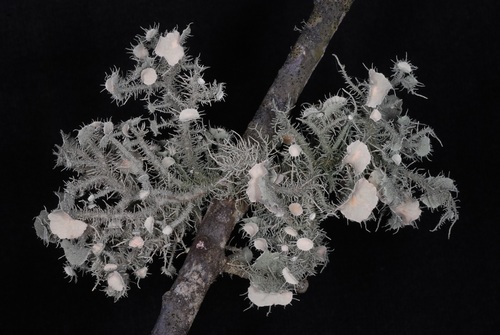
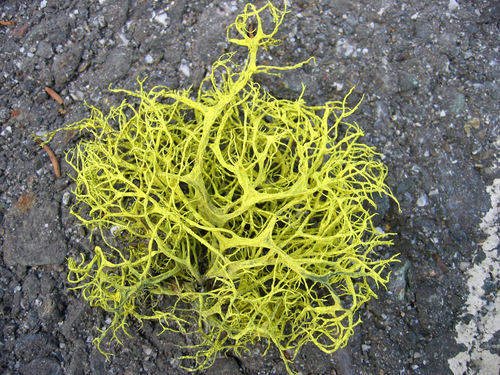
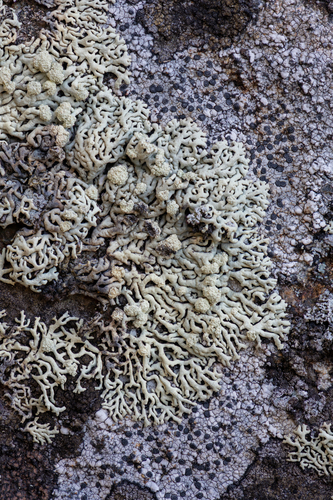
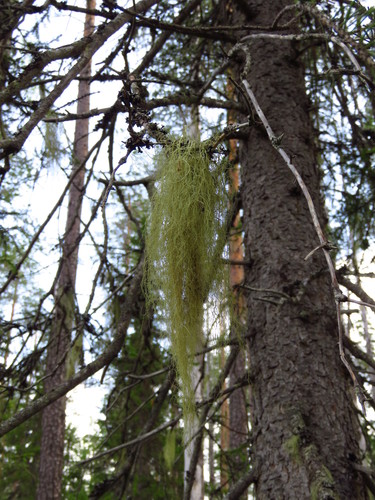
Usnea articulata (L.) Hoffm. is a fruticose (bush-like) lichen. Its vegetative tissue, called the thallus, is densely branched and forms tangled masses of prostrate or pendulous stems. Its branches are smooth, somewhat knobbly or spiny, and greenish-grey in colour. Larger stems develop an articulated structure, dividing into inflated, sausage-like segments. Unlike some similar lichens, the base of this species is not blackish; it sometimes detaches completely from its original substrate and continues growing while draped over another supporting plant or structure.
This lichen is extremely sensitive to air pollution, particularly sulphur dioxide. It has a widespread but sparse distribution across mainland Europe, but has gone extinct in many areas, and survives best in Brittany. It can also be found on various Mediterranean and Atlantic islands, in Saudi Arabia, and in the mountainous regions of East Africa and North Africa. In the British Isles, it was once widespread, but disappeared from many areas during the Industrial Revolution. It is reasonably common in southwestern England, from the New Forest westwards, and is found in scattered locations in Wales, especially Pembrokeshire. It is rare in southern and western Ireland.
In terms of habitat, it sometimes grows on the ground in slacks between sand dunes, over rough vegetation. More often, it grows on trees, frequently high in the tree canopy or in hedgerows. It typically is not attached directly to the tree, and instead drapes over twigs and branches. This growth habit means it is hard to spot from the ground, and its presence often only becomes noticeable when fragments fall to the ground during storms or after snowfall.
Like all lichens, this species forms a mutualistic symbiosis between a fungus and an alga. In Usnea articulata, the photosynthetic partner is a green alga, but it is not a member of the genus Trentepohlia. This species reproduces mainly through fragmentation of the thallus. It does not appear to produce spores, which limits its ability to recolonize areas where it was previously extirpated.