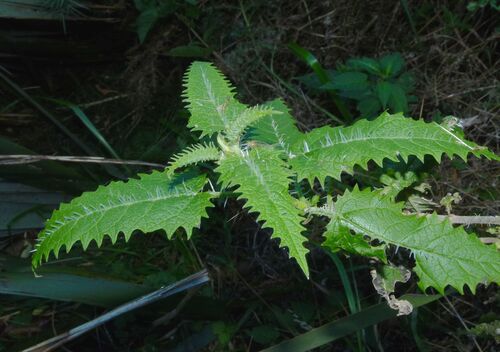
About Urtica ferox G.Forst.
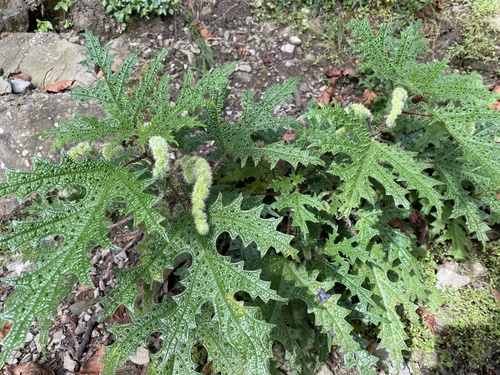
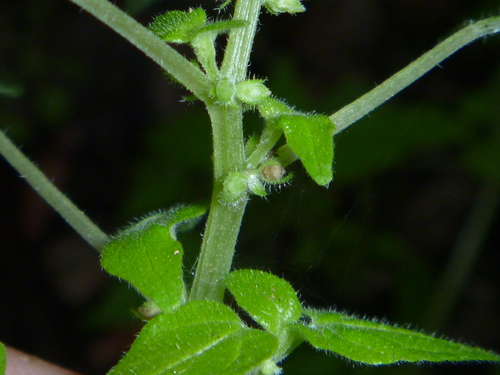
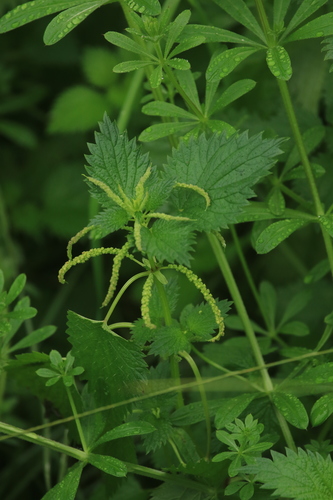
Urtica ferox G.Forst., commonly called ongaonga or tree nettle, can reach up to 3 m (9.8 ft) in height, with a stem base up to 12 cm (4.7 in) thick. Its pale green leaves are very thin and membrane-like. The leaf surface, stems, and stalks are covered in stiff stinging hairs that can grow up to 6 mm (0.24 in) long; these prominent spines line the distinct mid-vein and leaf margin. Individual leaves measure 3–5 cm (1.2–2.0 in) wide and 8–12 cm (3.1–4.7 in) long. They are arranged oppositely on the stem, with two stipules at each node. Leaves have an ovate-triangular shape, and their serrated margins carry a spine up to 1 mm (0.039 in) long on each tooth. Spines on older, darker bark are smaller and softer, and do not cause stings.
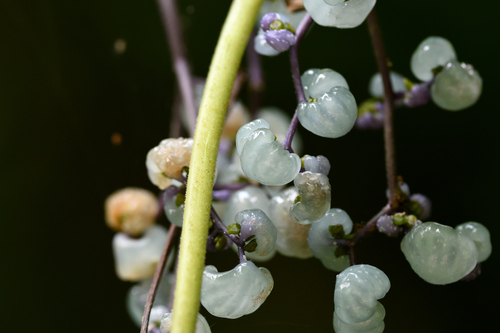
This nettle is winter deciduous in cold climates, evergreen in mild climates, and will shed leaves during drought if growing in shallow soil. Flowering occurs between November and March. As a dioecious shrub, it cross-pollinates via wind: pollen is captured by the densely packed stigmas of female flowers. Seeds are dispersed by rolling, wind, and birds. The fruits are achenes that mature in January, each holding one 1.5 mm long, brown, ovoid seed that germinates in one month. In a study of germination behavior across five vascular seed plant species, researcher C. J. Burrows found that Urtica ferox had the lowest germination rate at 59%, compared to over 85% for the other studied species. Burrows hypothesized that the species can build up a large, multi-year persistent seed bank in soil, noting that European Urtica species form similar seed banks.
Urtica ferox is endemic to New Zealand, where it grows in coastal and lowland forests and shrublands across the North Island, South Island, and Stewart Island. It is common in forest clearings and margins, often forming large patches, from sea level up to 600 m (1,969 ft) above sea level. It has also been recorded growing along stream beds on the Hen and Chicken Islands.
Although Urtica ferox is a toxic shrub, it plays a key ecological role for two native New Zealand butterflies: the red admiral (Vanessa gonerilla) and yellow admiral (Vanessa itea). Tree nettle leaves are the preferred food and source of protection for the butterflies' larvae. When larvae move onto leaves, they curl the leaf tip, use silk to hold the leaf in place, and build a protected shelter where they feed. Caterpillar activity can cause damaged leaves to fall off the shrub. Both butterfly species lay their eggs on nettle leaves during spring and summer, and eggs take 8 to 10 days to incubate. Introduced mammalian pests including common brushtail possums, goats, and deer also eat tree nettle leaves. Since no non-flying, non-marine mammals were native to New Zealand before human arrival within the last 1,000 years, the species has not adapted to grazing by these mammals.
Urtica ferox requires the high nutrient levels found in cycling forest systems like those of native New Zealand forests, where a rich A-type soil horizon of leaf litter and humus 10 to 80 cm thick is common. The species does not compete directly with other plants, instead growing in boundary zones between vegetation strata, which allows it to access the high soil fertility it needs. Like other nettle family species, it grows well in nutrient-rich soils, particularly those with high nitrogen content. With access to open sunlight and rainwater, it grows rapidly to take advantage of gaps created by natural events such as tree fall, landslides, and flooding that remove dominant old-growth vegetation.
In Māori culture, ongaonga appears in folklore: Kupe is said to have placed ongaonga and other obstacles to hinder pursuers whose wives he had stolen. In traditional Māori rongoā medicine, tree nettle bark boiled together with kawakawa leaves was used to treat skin conditions. Tree nettle leaves were also used to treat pain, and a decoction of leaves and young twigs prepared in boiled water was used for stomach ache and as a treatment for gonorrhea. Ongaonga was also a traditional Māori food source. After removing leaves and outer bark, the inner stems were sometimes consumed. The thin inner bark film was also eaten raw, and reported to have a sweet taste. There are also records of de-leaved stems being cooked before consumption.