About Uropsila leucogastra (Gould, 1837)
The white-bellied wren, scientifically named Uropsila leucogastra (Gould, 1837), measures 9.5 to 10 cm (3.7 to 3.9 in) in length. Males weigh between 9.8 and 10.5 g (0.35 to 0.37 oz), while females weigh between 8 and 9.1 g (0.28 to 0.32 oz).
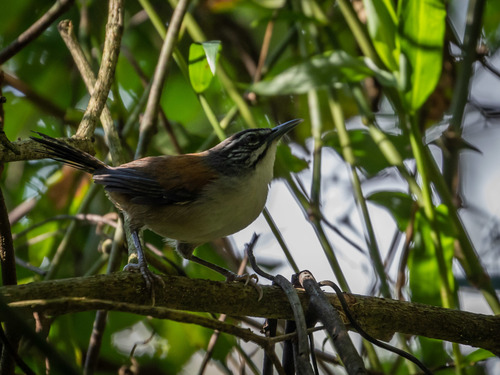
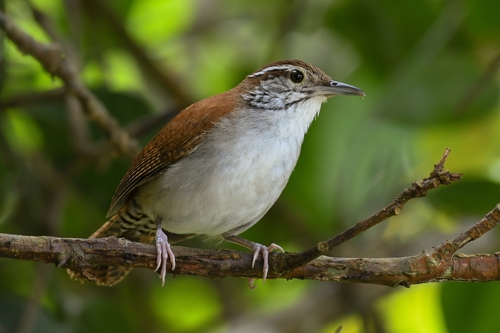
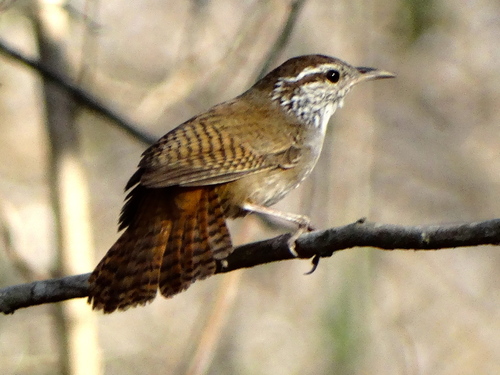
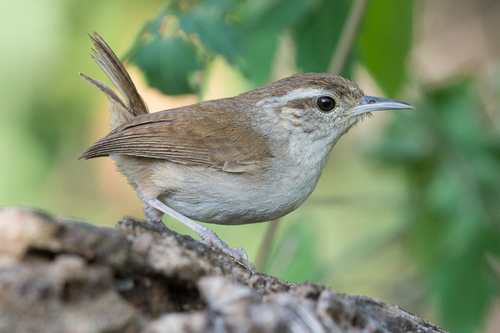
The nominate subspecies of the white-bellied wren has a medium brown crown, upperparts, and tail. Its rump is slightly reddish, and its tail is marked with many thin dark bars. It has a gray-white supercilium, a medium brown stripe behind the eye, and brown-mottled gray cheeks. Its throat, chest, and upper belly are gray, and its flanks and vent area are buff. Other subspecies differ slightly in the intensity of the brown coloring of their upperparts and the appearance of the bars on their tails.
The species has two widely separated populations. The subspecies U. l. pacifica occurs in western Mexico, from southern Nayarit south into Guerrero. All other subspecies range from southern Tamaulipas in northeastern Mexico south through the Yucatan Peninsula, Belize, and northern Guatemala, with a small separate population in northern Honduras.
The white-bellied wren lives in a variety of woodland types, from the semi-arid forest of western Mexico to the humid rainforest of the Yucatan Peninsula. In northeastern Mexico, it is commonly found in thickets of wild pineapple (Bromelia pinguin). It occurs at elevations ranging from sea level up to 500 m (1,600 ft).