About Uropeltis macrolepis (Peters, 1862)
Taxonomic Background
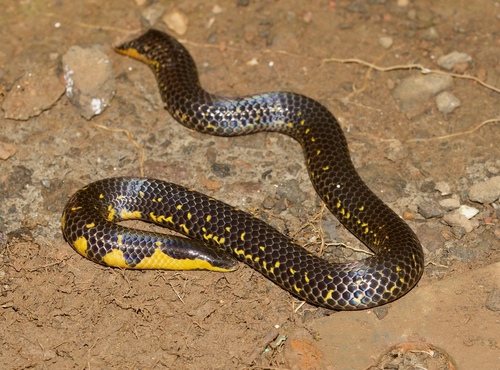
Uropeltis macrolepis, first described by Peters in 1862, is black or dark purplish brown on both its dorsal (upper) and ventral (under) surfaces, and every individual scale has lighter-colored edges.
Body Coloration
This species has a yellow stripe along the lips and the sides of the neck, which is followed by two to five large yellow spots, plus a yellow stripe running along each side of the tail.
Adult Size
Fully grown adults can reach a total length of 29.5 cm (11+1⁄2 inches) including the tail.
Dorsal Scale Arrangement
Smooth dorsal scales are arranged in just 15 rows at midbody, and in 17 rows behind the head.
Ventral and Subcaudal Scale Counts
There are 128 to 140 ventral scales, and 7 to 9 subcaudal scales.
Snout Shape
The snout of Uropeltis macrolepis is rounded.
Rostral Scale Characteristics
The rostral scale makes up less than one quarter of the length of the shielded portion of the head, and the portion of the rostral visible from above is shorter than the distance between the rostral and the frontal scale.
Nasal Scale Position
The nasal scales contact each other behind the rostral scale.
Frontal Scale Dimensions
The frontal scale is as long as, or slightly longer than, it is broad.
Eye and Ocular Shield Proportion
The diameter of the eye is more than half the length of the ocular shield.
Body Length to Diameter Ratio
The total body length is 24 to 29 times the body diameter.
Ventral Scale Size Comparison
Ventral scales are twice as large as the adjacent contiguous scales.
Tail Morphology
The end of the tail is obliquely cut off (truncate), flattened on the dorsal side, and covered with strongly bicarinate (double-keeled) scales.
Terminal Tail Scale Features
The terminal tail scale has a transverse ridge and two points.
Species Distribution
This species is found in Maharashtra, India, with recorded locations including Phansad near Supegaon, Mahabaleshwar, Koyna, and Lonavla.
Subspecies Type Locality
The type locality for the subspecies Uropeltis macrolepis mableshwarensis is "Mahableshwar, Satara district, Bombay State", India.
Habitat and Altitude Range
Its preferred natural habitat is forest, occurring at altitudes ranging from 10 m to 1,350 m (33 ft to 4,429 ft).
Reproduction Mode
Uropeltis macrolepis reproduces via ovoviviparity.


