About Urocissa ornata (Wagler, 1829)
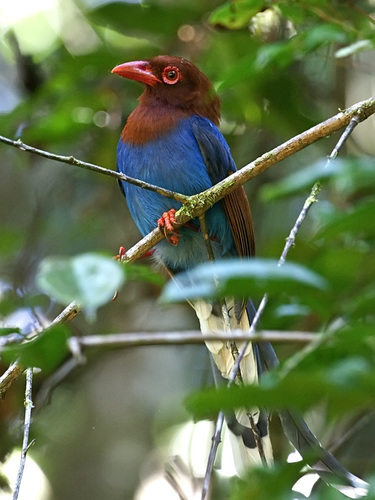
Urocissa ornata, commonly known as the Sri Lanka blue magpie, measures 42–47 cm in total length. It is larger than a mynah, smaller than a crow, and has a sturdy bill. Its body plumage is bright blue, while its head, neck, and wings are reddish-brown or chestnut. The long blue tail is graduated and ends in a white tip. The bill, legs, feet, and unfeathered eye ring are all a bright vibrant red. Males and females of this species have identical external appearance. Juveniles have similar plumage to adults, but are overall duller; they have a brown eye ring, and their blue feathers carry a greyish tint that is most noticeable on the underside. The moulting season for this species runs from August to November. The Sri Lanka blue magpie is endemic to Sri Lanka. It inhabits tall, undisturbed forest in the mountains, foothills, and adjacent lowlands of the country's wet zone, occurring at elevations from below 150 m up to 2150 m. It is rarely found in disturbed habitats such as gardens or plantations. Surveys carried out between 2004 and 2006 recorded individuals of the species in 38 separate forest patches located within six forest complexes across its range in the wet zone of southern Sri Lanka. This species is monogamous and engages in cooperative breeding to raise its young. It can be found in small flocks of up to seven birds, and each individual bird maintains its own territory. The generation length of the Sri Lanka blue magpie is 6.7 years. The breeding season occurs from January to March. Clutches contain three to five white eggs marked with brown spots. Nests are cup-shaped, built on top of small, slender trees, and lined with soft materials such as lichen. Both sexes contribute to building the nest and feeding offspring; only the female incubates the eggs.