About Urocissa flavirostris (Blyth, 1846)
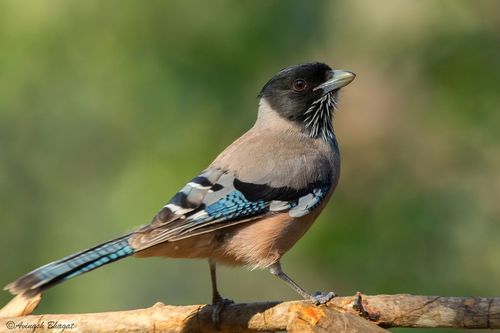
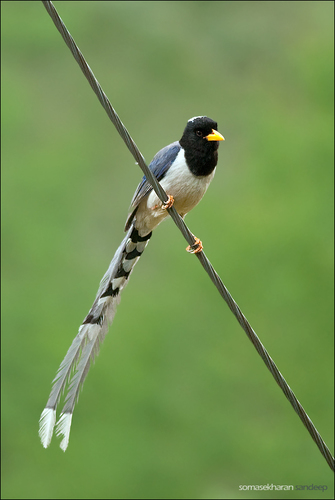
Yellow-billed blue magpie (Urocissa flavirostris) measures 66 cm (26 inches) in total length, including a tail that is approximately 46 cm (18 inches) long. Males and females have identical plumage. The head, neck, and breast are black, with a distinct white patch on the nape. The rest of the lower plumage is white, with a faint lilac tint. All of the upper plumage is purplish-blue, with brighter color on the wings and tail. Flight feathers are tipped with white, and the outermost wing feathers are also white. The tail is long and graduated, made up of blue feathers tipped with white; this pattern does not apply to the very long central pair of tail feathers, which have a black band just before the white tip. The yellow-billed blue magpie occurs across the Himalayas, ranging from Hazara to the Brahmaputra. This species is split into two subspecies. The more common subspecies, U. f. cucullata, is found from the western edge of the species' range to Western Nepal. It is common across most hill stations in the Western Himalayas, and breeds at elevations between 1,500 and 3,000 m (4,900 to 9,800 ft). The eastern subspecies occurs from Eastern Nepal eastward. It differs from the western subspecies by having a darker lilac tint on its underparts. Its breeding elevation zone is slightly higher than that of the western subspecies, and it rarely occurs as low as 1,830 m (6,000 ft). The yellow-billed blue magpie is a resident species, but typically moves to lower elevations during the winter. From Simla eastward, the closely related red-billed blue magpie (Urocissa erythroryncha) often shares the same areas as the yellow-billed blue magpie. The red-billed blue magpie is especially common around Mussoorie, Tehri-Garhwal, Kumaon, and in Nepal. It can be easily distinguished from the yellow-billed blue magpie by its red beak and larger white nape patch.