About Urochloa trichopus (Hochst.) Stapf
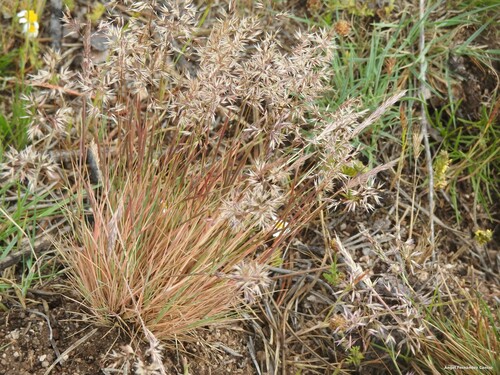
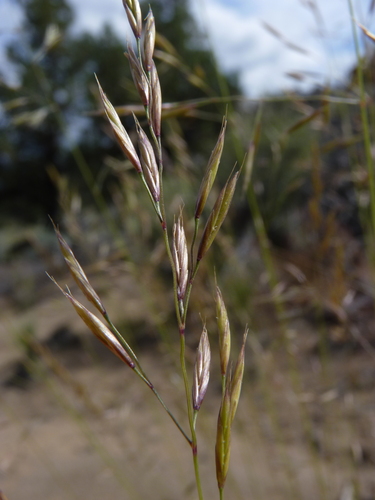
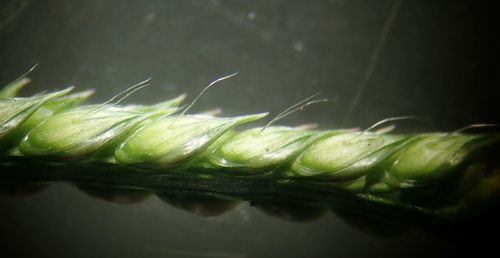
Urochloa trichopus is a clump-forming grass that can grow up to 1.7 meters (5 feet 6.9 inches) tall, with alternately spaced leaves. Its leaf sheaths range from glabrous (hairless) to slightly pubescent (bearing small hairs). Leaf blades are linear and acuminate (tapering to a long point), measuring 5–30 mm (0.2–1.2 in) in length and 5–20 mm (0.2–0.8 in) in width. Its inflorescence holds 3–20 racemes arranged along a 4–20 cm (1.6–7.9 in) long central axis. It bears solitary, ovate-shaped spikelets on a narrowly winged rachis (the central floral shaft). Each spikelet contains two florets: the lower floret is male, while the upper is bisexual. This species has 3 stamens, and the ovary has 2 plumose (feather-like) stigmas. Its seed is a strongly flattened caryopsis (grain). It flowers and fruits between June and August. This species is native to multiple African countries: Angola, Botswana, Burkina, Cameroon, Chad, Congo, Eritrea, Ethiopia, Ivory Coast, Kenya, Malawi, Mali, Mauritania, Mozambique, Namibia (including the Caprivi Strip), Niger, Nigeria, Senegal, Somalia, South Africa (within the Cape Provinces, Free State, KwaZulu-Natal and the Northern Provinces), Sudan, Swaziland, Tanzania, Uganda, Zambia, Zaïre, and Zimbabwe. In Arabia, it occurs in Saudi Arabia and Yemen. It was first recorded in Telangana state, India in 2021. It grows at altitudes up to 1,500 m (4,900 ft) above sea level in semi-arid climates, found in grassland and savanna woodland. It also grows in disturbed locations and occurs as an arable weed. The seeds of Urochloa trichopus are collected for human consumption in regions including Kordofan (Sudan), Tanzania, Botswana, and Zimbabwe. In Botswana, the seeds are ground into flour, which is used as a cereal; the flour can be mixed with water, milk, or melon juice and made into cake. It also serves as good quality fodder in India.